
In the past, when equipment-room power and environment monitoring was discussed, projects often started from the status of equipment such as the UPS, power distribution, air conditioning, temperature and humidity, and water leak. Today, in industrial-grade AIoT and IoT projects, Guangzhou Tongwei Smart Technology Co., Ltd. (Tongwei Smart) keeps the questions going: how much electricity did the equipment room use, which systems and time periods did the consumption fall in, who checks an anomaly, and how is an improvement verified afterward? When data extends from equipment status to the energy-use structure and to operations actions, power and environment monitoring becomes an important entry to energy operations.
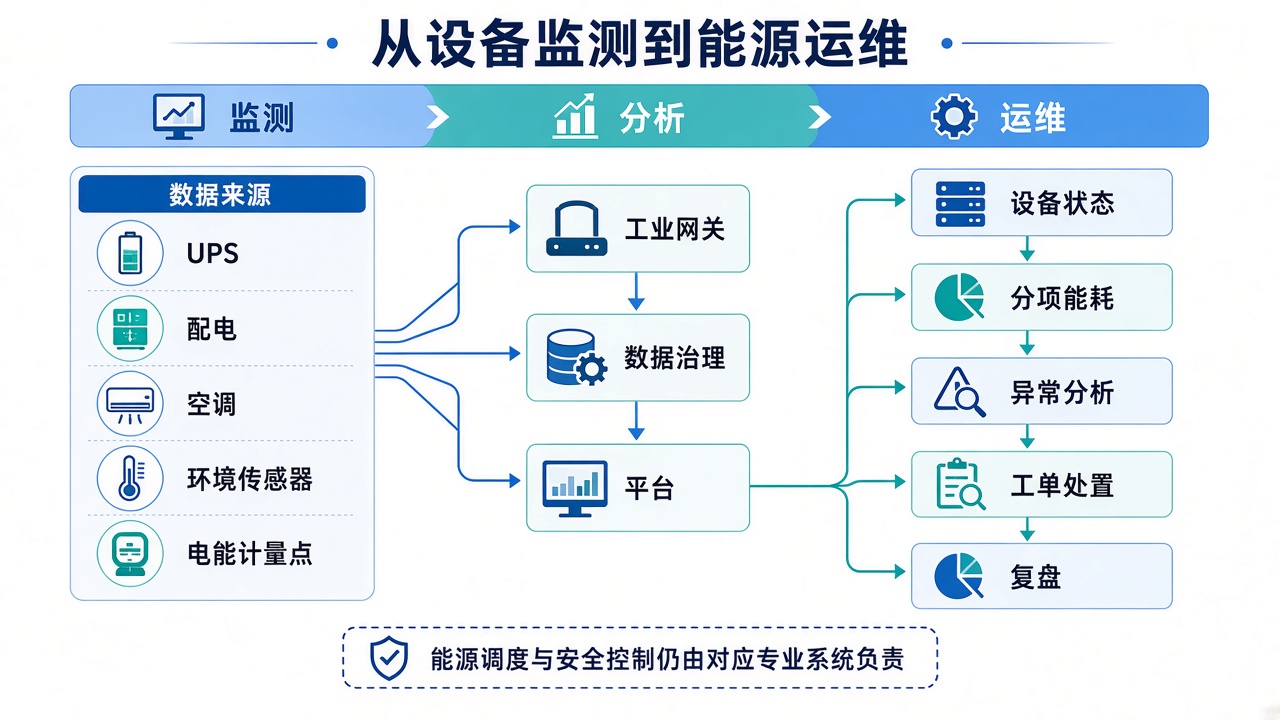
From equipment-status monitoring to energy operations
What traditional equipment-room power and environment monitoring has to answer first is "whether the equipment is normal": whether utility power is interrupted, whether the UPS is in an abnormal state, whether a distribution circuit is in alarm, whether the air conditioner is running, whether temperature and humidity are over limit, and whether there is a water leak or an access-control anomaly. This information bears on whether the equipment-room facilities can keep running, and it is also the basis of on-site watch and fault handling.
Once the view extends to energy management, several more layers of questions are added: how much electricity did the equipment room or site consume? What is the energy-use share of different areas, systems, or devices? Which time period showed an unusual swing? Did a change in equipment status come with a change in energy use? After an anomaly is found, who checks it, what measure is taken, and how is the result reviewed?
These classes of question are related to each other, but the focus differs:
| Management layer | Main focus | Management action it can form |
|---|---|---|
| Power and environment status | Whether the UPS, power distribution, air conditioning, temperature and humidity, water leak, and similar items are normal | Equipment alarms, inspection, fault handling |
| Energy monitoring | Which areas, systems, or time periods the main meter and sub-item metering reflect | Trend viewing, statistics by category, anomaly checks |
| Energy-efficiency management | Whether the change in energy use is reasonable, and whether there is verifiable room to improve | Set a baseline, analyze the difference, propose an adjustment |
| Energy operations | Whether someone follows up on an anomaly, whether the measure is carried out, and whether the result can be rechecked | Alarms, dispatch, on-site feedback, review of the effect |
So the capability range of power and environment monitoring can extend toward energy monitoring, energy-efficiency analysis, and energy operations. Whether those capabilities are actually in place still depends on on-site metering points, data quality, system interfaces, and the actual operations process. Adding an energy dashboard to an equipment room does not automatically form energy-saving management.
Energy monitoring has to get the data relationships straight
Judging whether energy use is abnormal cannot rest on a single total-electricity curve. At a minimum, you need to know what each metering point measures, which area or device it corresponds to, where the data comes from, what the sampling period is, and how missing values or jumps are handled. If energy efficiency is also to be compared across sites or devices, the metering boundaries and statistical definitions also have to be confirmed as consistent.
For example, data on the UPS input side, the output side, and the equipment-room main incomer represent different scopes. Whether the air-conditioning system is metered on its own also affects the judgment of the equipment room's energy-use structure. If metering points are not matched to equipment, areas, and owners, a manager may be able to see the numbers but cannot confirm who should do the check and where handling should start.
Equipment status and energy data should also be analyzed together where possible. When temperature is on the high side, besides checking air-conditioner alarms, the running status and electricity change of the related equipment can also be checked. When the energy curve changes suddenly, it also has to be confirmed whether there is added load, a change in equipment operating strategy, a metering anomaly, or a communication outage. Data correlation can only help narrow the scope of investigation. The specific cause still has to be confirmed against the situation on site.
How power and environment monitoring and energy management work together
A coordination path that can be put into practice can be designed in four steps:
- Connect equipment and metering data. Acquire the UPS, power distribution, air conditioning, and the applicable electrical energy metering points. If the site already has building automation, an energy system, or another platform, first confirm the interfaces and data responsibility, and reduce duplicate acquisition.
- Set unified data definitions. Map points to sites, areas, equipment, and metering boundaries, and check units, timestamps, sampling periods, missing data, and quality status.
- Form analysis that can be explained. Depending on the data conditions, look at energy trends, submetering by category, differences by time period, and abnormal changes. Analyses such as peak-flat-valley, demand, and specific consumption are meaningful only when necessary data such as metering scope, tariff, or output is complete.
- Let anomalies enter the operations process. For situations that need a check, set alarms and an owner, and record the check, the handling, the feedback, and the recheck result. Later, compare the data before and after the adjustment, and confirm whether the measure was effective.
An industrial gateway can take on on-site device access, data aggregation, and protocol adaptation. When network conditions or the project configuration require it, it can also take on data caching and edge processing. A central platform is better suited to unified management of the equipment ledger, historical data, alarms, work orders, inspection, and reports. Tongwei's industrial-grade AIoT plan can combine industrial gateways, expansion modules, the platform, and implementation services according to the on-site objects and the system interfaces. The specific access scope and function configuration should be based on the equipment list, the point tables, and the project plan.
Tongwei Smart treats equipment rooms and power and environment, and energy efficiency and energy management, as related mature scenarios that each have their own emphasis. During engineering implementation, the two classes of data and operations process can be joined in one device–edge–cloud architecture, while the metering boundary, alarm responsibility, and acceptance requirements of equipment-room running assurance and of energy analysis are each stated clearly.
Energy-saving results have to be verified through operations actions
What energy monitoring provides is a basis for observation. Energy-saving management also needs a baseline, improvement measures that can be carried out, and a check of the result after implementation. The baseline should use a time range that can be compared, and it should also take into account changes in season, business load, equipment running time, and conditions of use. When the conditions are not consistent, simply comparing total electricity over two time periods can produce a wrong conclusion.
Energy operations also includes maintenance of the equipment and of the data itself: whether meters are online, whether acquired values are trustworthy, whether a communication outage was reported in afterward, whether points are mapped incorrectly, and whether someone follows up on alarms. Data anomalies, equipment faults, and changes in energy use need to enter the check process that corresponds to each of them, and the results then go back into the ledger, the analysis, and the later maintenance plan.
The boundary also has to be stated in advance. Power and environment monitoring and energy management can support monitoring, analysis, alarms, and operations coordination, but that cannot be taken by default to replace a complete EMS, real-time energy dispatch, production control, on-site protection, or fire interlocks. Where remote write or linkage is involved, authorization, scope limits, fault fallback, and operation audit should be confirmed separately, and the responsibility boundary of the existing control system should be kept.
Start verification from one site
If the existing system mainly watches UPS, power distribution, and environmental status, you can first pick one equipment room or site and take stock of the existing monitoring points, meters, the correspondence between equipment and areas, the data interfaces, and how anomalies are handled. Then pick one concrete question as the verification target, for example whether sub-item energy use is traceable, who checks abnormal energy use, or whether a handling measure can be rechecked from the data.
The foundation of power and environment monitoring is still keeping the facilities running. When equipment status, energy data, and operations actions are joined into a closed loop, it can provide a more complete on-site basis for energy management. Tongwei Smart suggests starting from one list of equipment and metering points, first verifying the data and the responsibility boundaries, and then deciding which energy-efficiency analyses and operations processes to extend into.