
What a duty room fears most is not a screen with no alarms. It is alarms coming one after another, until in the end no one can say which one matters most. After an air conditioner stops and the temperature rises, the system may report, in sequence, an air-conditioner fault, abnormal supply air, and high temperature in several areas. Contact chatter at the same leak point can also pop up more than ten times within a few minutes. The list is busy, and the real fault is squeezed inside it.
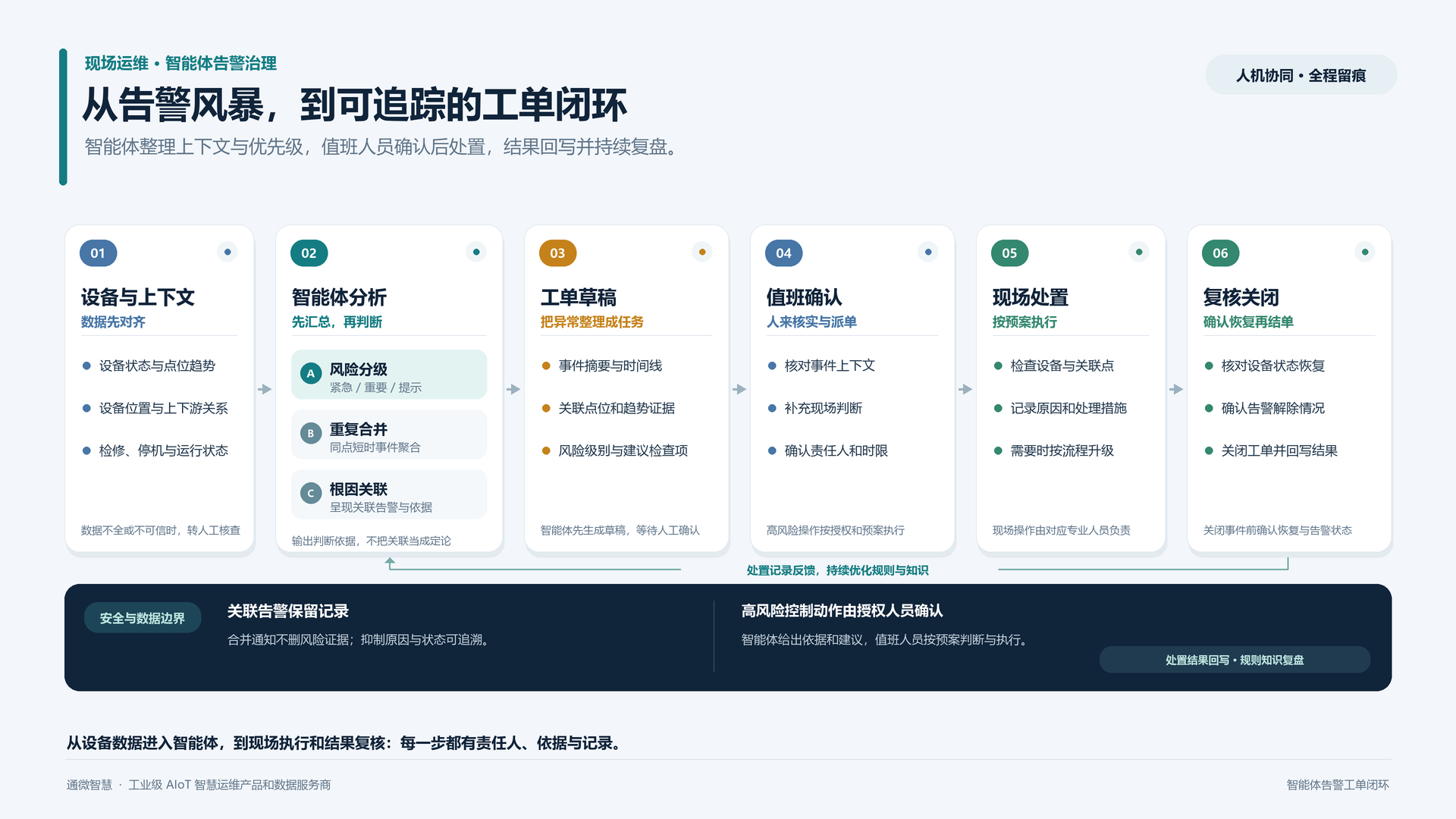
People who have worked on site know that a large number of alarms does not equal good management. On-duty staff being buried by alarms is the real pain in operations. In recent years the direction of industrial AI has also been moving from "looking at data and giving prompts" toward "understanding operating context and supporting action." On 26 October 2026, Honeywell released Forge Plant Cognition and announced that it would first cooperate with the Dangote refinery, combining real-time operating data, process knowledge, and physical models, and using technologies such as AI agents and digital twins, to help identify constraints, find problems, and support operating decisions. Honeywell press release This is public news from a large process-industry scenario. It does not mean that every building or power and environment platform already has the same capability. But it gives on-site operations a direction worth attention: a system should move from piling up alarms toward turning anomalies into tasks that have a priority, can be handled, and can be tracked.
Alarm count is not operations quality
Traditional alarm rules usually center on a single point: alarm when the value is over the upper limit, and alarm when it is under the lower limit. They are suited to finding a clear limit breach, but they do not naturally understand relationships on site. The system knows that "the temperature is high," and may not know that the air conditioner has just stopped. It knows that several points are in alarm at the same time, and may not be able to judge whether they are caused by the same root cause.
So the goal of alarm governance is not to press the alarm count down. It is to let on-duty staff answer four questions as soon as possible: what happened? How large is the impact? What is the most likely cause? Who does what next? If an agent cannot help answer these questions, and only repeats the alarms in another form, it has not solved the on-site problem.
An agent has to read the alarm context first
In power and environment and building scenarios, an agent needs context that is reliable enough, including the equipment ledger and location, the meaning and unit of each point, running / stopped / servicing status, real-time values and historical trends, the upstream and downstream relationships between equipment, the alarm rules, the duty roster, and the handling plan. Without this foundation, a model easily treats similar wording as the same fault, and may also mistake correlation for a causal relationship.
When putting this into practice, the suggestion is to start from read-only analysis and assisted judgment: first have the system summarize events for the same equipment, the same area, and the same time period, and give the basis of the correlation and the uncertainty. After operations staff confirm it, settle it as a rule, a knowledge entry, or a work-order template. Before data quality, equipment coding, and the responsibility boundary are straightened out, letting AI control equipment directly carries high risk and a high maintenance cost.
Four steps to turn alarms into executable tasks
Step 1: grade by risk, rather than one cut across every point. First divide alarms into urgent, important, and advisory. Events that may affect safety or business continuity, such as a water leak, a critical power-distribution anomaly, and an abnormal key UPS state, should be configured at high priority according to the on-site plan. A slight temperature or humidity deviation, a trend change, or information that needs a daytime recheck can enter advisory or the to-do list. The grade has to be tied to the scope of impact, the duration, the handling time limit, and the notification target. Threshold numbers should be confirmed from design requirements, equipment specifications, and actual operating conditions. They cannot be copied directly from another project.
Step 2: merge repeat alarms, but keep the event evidence. If the same measurement point stays over limit for a short time, notify immediately the first time, then merge what follows into the same event, and add the duration, the peak value, and the state changes. After recovery, record the recovery time. If it triggers again, use the rules to judge whether it is a new event. The suppression policy must make it possible to find out the reason it was held down, the window length, the operator, and the recovery condition. An urgent alarm cannot be blocked indefinitely by ordinary deduplication logic.
Step 3: present the possible root cause, and do not delete the related risk. For example, after an air conditioner stops and the temperature rises step by step, the system can list the air-conditioner fault as the primary event and the temperature-rise alarm as a related effect, and give on-duty staff a first place to start checking. But the temperature rise is still a real risk signal. It should stay in the event record, and whether to notify it separately should be decided by severity. The more accurate practice of "report only the root cause" is "present the root cause first, merge repeat notifications, and keep the related events," rather than leaving only one message and dropping the rest of the evidence.
Step 4: connect confirmation and handling to the work order. A high-grade event should have a clear owner, a confirmation time limit, and an escalation path. An important alarm can automatically generate a work-order draft, carrying the equipment, the location, a trend screenshot, the related alarms, the suggested checks, and the handling plan. After staff confirm, it is dispatched. The handling process records the cause, the measure, the parts replaced, and the recovery result. When the work order is closed, check again whether the equipment status has recovered and whether the alarm has cleared, so as to avoid "the work order is closed, and the fault is still there."
From advice to automatic execution, permissions need to be layered
An agent can first take on assistance such as alarm summaries, risk ranking, suggestions to merge repeats, presentation of related events, pre-filling of work-order fields, and knowledge retrieval. Each judgment should preferably state its basis: which points, time window, equipment relationships, and rules were used. When the evidence is insufficient, it should clearly prompt a manual check, rather than making up a definite conclusion.
Actions that involve starting or stopping equipment, changing a threshold, inhibiting an alarm, a power-distribution operation, or a control action that may affect safety should be managed according to the system boundary and the approval system. At the start, the main modes are read-only analysis, human confirmation, and auditable rule execution. After on-site verification, limited automation is opened step by step. Every operation needs a record, must be able to roll back, and must stay consistent with the safety interlocks and the emergency plan of the existing control system.
Go-live assessment should also not look only at "how many fewer alarms there are." Valid-alarm rate, the share of repeat notifications, urgent-alarm confirmation time, the on-time work-order completion rate, wrongly suppressed events, and missed-alarm records can be checked together. Trial-run for one week, or pick one site to verify first, review the rules category by category, and then widen the scope. The definitions of the metrics should be agreed in advance by the customer, operations, and the technical team.
When an experienced engineer looks at a new technology, what is looked at in the end is still whether it can save on-duty staff a detour. In power and environment and building plans, Tongwei Smart can do engineering configuration around threshold grading, repeat suppression, root-cause correlation, turning alarms into work orders, and a handling closed loop. The value of an agent is not taking every judgment in place of the on-duty staff. It is sorting scattered information into a clear priority and a next action, so that a fault that truly needs handling is no longer buried in the noise.