
Many equipment maintenance plans are scheduled by the calendar: monthly inspection, quarterly servicing, and yearly replacement of certain consumables. That work is necessary, but a calendar does not know that a fan’s vibration has recently increased, and it does not know that the voltage of one cell in a UPS battery string is drifting away from the other cells in the same string. Another common case is rushing a repair only after equipment has failed. When the fault occurs, the team finds that spare parts are not in stock, the night shift is short-handed, or the impact of the shutdown is larger than expected.
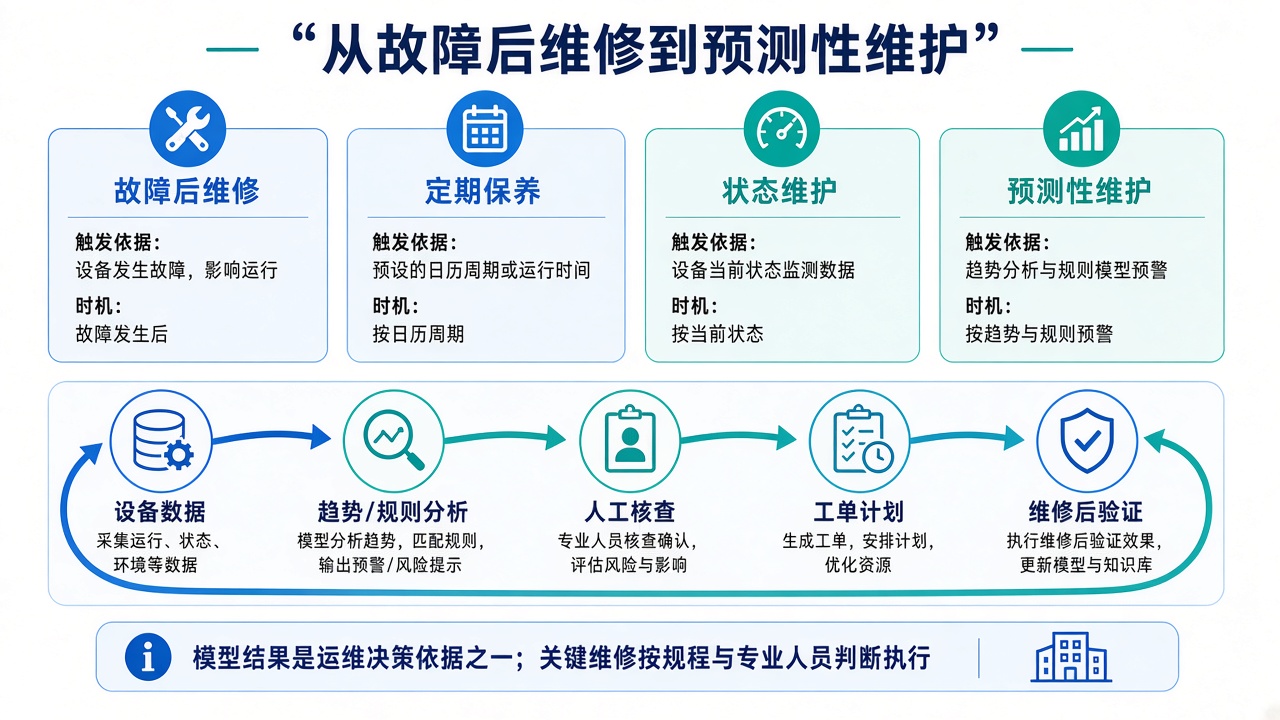
The point of predictive maintenance is to move the maintenance timing forward from a “fixed date” or from “already failed” to “condition has started to degrade, and there is still time to arrange a response.” The U.S. Department of Energy Federal Energy Management Program describes condition-based maintenance and predictive maintenance as detecting the onset of performance degradation, so that correction can be made before the equipment fails or users notice. Its building energy-management material also cites monitorable examples such as air-conditioning filter differential pressure and changes in heat-exchanger heat transfer. U.S. Department of Energy: EMIS capabilities and condition-based/predictive maintenance
From the field point of view, predictive maintenance is not “install sensors and you can predict the day it fails.” It is a process of continuous improvement: collect trustworthy data, know what normal operation looks like, identify a deviation in time, send people to confirm it, create a work order according to risk, and then check whether the maintenance resolved the problem.
What predictive maintenance addresses
Operations practice can be grouped simply into three types. Repair after failure is handled after a fault occurs. Scheduled preventive maintenance follows time, operating hours, or the manufacturer’s requirements. Condition-based maintenance triggers inspection or repair from the equipment’s current condition. Predictive maintenance uses ongoing trends and diagnostic information to estimate degradation risk or the remaining window for action, so operations can arrange resources earlier. In actual projects, condition-based maintenance and predictive maintenance often overlap. The name matters less than whether the data and the work process are effective.
For equipment rooms, buildings, and campuses, the value shows up mainly in several ways: fewer sudden shutdowns and emergency repairs; less over-maintenance of equipment that is still in good condition; spare parts and people prepared earlier; hidden energy waste from falling equipment efficiency or abnormal control is found; and inspection effort shifts from “look at every piece of equipment” to checking higher-risk equipment first.
The boundary needs to be stated clearly: a trend anomaly found by the platform does not automatically mean the equipment is about to fail. Sensor drift, load changes, seasonal conditions, and operating-strategy changes can all produce similar behavior. The system should provide the signal, the evidence, and a priority. People who know the equipment review it, and then decide whether to repair.
Which signals to watch on power and environment equipment and building equipment
UPS and batteries. Parameters the equipment supports can include cell voltage, differences between strings, temperature, charge and discharge state, alarm history, and internal resistance or conductance. Judgment should combine battery type, manufacturer requirements, ambient temperature, and periodic test results. An anomaly in a single parameter is suitable for triggering a review. It cannot, outside the procedure, be taken to mean the battery will certainly fail.
Air conditioning and HVAC equipment. Observable items include compressor and fan start-stop frequency, operating current, supply and return air temperature, chilled-water supply and return temperature difference, valve position, filter differential pressure, and equipment run time. A filter differential pressure that keeps rising can prompt a check for blockage. Equipment that runs for a long time while the temperature difference or the cooling effect worsens may need checks of heat transfer, flow, sensors, or control strategy. A specific diagnosis has to be made against the equipment’s operating condition. A single trend cannot be treated as a confirmed cause.
Pumps, fans, and motors. On critical equipment, vibration, bearing temperature, current, speed, differential pressure, flow, and start-stop counts can be read together to see whether a change persists. Load changes affect some signals, so operating state and duty conditions need to be read at the same time, so that normal variable-frequency adjustment is not judged to be a fault.
Power distribution and environment. Circuit current, voltage, power factor, temperature rise, switch state, ambient temperature and humidity, water leakage, access control, and communication status can be read together. For objects that affect safety or business continuity, reliable measurement points, continuous collection, and alarms that can reach people should come first. Complex models come after that.
Four methods commonly used in the field
Thresholds and rules. Engineers set upper and lower limits, duration, rate of change, or logical relationships between points from equipment specifications, operating boundaries, and experience. Rules are transparent and easy to explain. They suit critical alarms and objects that already have a clear failure mechanism. Thresholds need to account for deadband, start-stop state, and maintenance mode, or they easily produce false alarms.
Trends and baseline comparison. Time-series comparison of operating hours, temperature difference, differential pressure, current, energy use, and similar quantities finds equipment that keeps departing from its historical baseline. Baselines need to be grouped by season, weekday and weekend, load, outdoor weather, and equipment mode. Otherwise a normal change in operating condition can be misjudged.
Fault detection and diagnostic rules. Several points and equipment relationships are judged together. For example, the valve is open and the fan is running, but the temperature response does not meet expectations; or the relationship between differential pressure and flow is abnormal while a pump is running. The U.S. Department of Energy lists automated fault detection and diagnostics as an energy-management system capability, and notes that it can help identify faults, performance degradation, control problems, and operating-sequence problems in HVAC or critical mechanical systems. U.S. Department of Energy: EMIS capabilities
Statistical or machine-learning models. When data volume and quality are sufficient, models can be built for load forecasting, anomaly detection, fault-mode classification, or remaining-life estimation. Models should be validated against historical events and field confirmation, checked regularly for drift, and explained to maintenance staff in terms of the main evidence. Without fault labels, an equipment ledger, and stable operating data, organizing the data and using rule-based diagnosis first is usually more reliable than going straight to a complex model.
Implementation path from data to work orders
First, choose the equipment rather than the algorithm. Rank by criticality, fault impact, repair cost, data availability, and existing fault frequency. Pilot one class of critical equipment first, such as UPS batteries in a critical equipment room, cooling-source equipment, or an important pump set.
Second, complete the equipment and measurement-point foundation. Unify equipment codes, locations, models, maintenance records, point units, and sampling intervals. Check sensor installation, calibration, and communication status. Data that cannot be collected, has inconsistent timestamps, or has unclear state labels is not suitable for direct use in prediction.
Third, establish baselines and rules. Select a normal operating period and mark equipment start-stop, maintenance, season, and load changes. Put explainable thresholds, durations, trend deviations, and multi-point relationships online first. Split alarms into advisory, important, and urgent, and define for each who looks at it, how soon they respond, and how it escalates.
Fourth, bring analysis results into daily maintenance. Diagnostic results need to be able to generate a task to be checked or a work order, including the equipment, the abnormal time window, related trends, possible causes, suggested checks, and risk level. After technicians confirm on site, record the actual cause, the repair action, and the result. That forms feedback that later rules and models can learn from.
Fifth, verify whether it is useful. During trial operation, watch lead time of detection, the share of valid alarms, the share of planned repairs, unplanned downtime, repeat repair calls, spare-parts readiness, and maintenance cost. Model accuracy or alarm volume alone is not enough. Confirm whether an alarm led the team to take an effective action earlier, and record false alarms and missed alarms as well.
Start with high-value equipment
Not every sensor and not every air damper is worth complex prediction. Objects that are critical, have large fault consequences, have long maintenance cycles, and have enough operating data are more suitable to start with. Ordinary equipment can continue on the manufacturer’s service cycle. Important equipment adds condition monitoring, and the level of diagnosis is raised step by step once the data foundation is in place.
Experienced engineers judge whether a predictive-maintenance project has landed by looking not at how many AI icons are on the large screen, but at whether the site prepared spare parts earlier because of a signal, adjusted a maintenance window, or kept a fault from growing, and at whether data and maintenance records can return to the system after a work order is closed. Running the process through for one equipment family, then expanding to the whole campus, is more practical than covering every piece of equipment at the start and ending with nobody to handle it.