
Someone wants the agent, right from the start, to dispatch work automatically and reset alarms automatically. The knowledge base does not even have the common fault codes collected, and the historical work orders are written vaguely. Guangzhou Tongwei Smart Technology Co., Ltd. (Tongwei Smart) has kept a restrained view of an industrial AI agent: let it assist inside IoT operations first. An industrial-grade AIoT should not reach for control the moment it comes in the door.
If the first job is chosen wrong, it is hard to pull back later
The work an agent is suited to, and the work that looks good in a demonstration, are often not the same kind. Automatic dispatch, automatic reset, and automatic parameter changes sound as if they save people. Once the basis is thin, a wrong order spreads faster than a person would spread it. Sending the wrong person, closing the wrong alarm, and issuing an operation while the state is unclear leave the responsibility hard to explain.
The more common starting point on site is ordinary. There are many alarms, and the duty operator has to judge which one to look at first. The same fault keeps returning, and a new person does not know how it was handled last time. Point names are not unified, so a query means asking a senior technician. These problems need sorting, retrieval, and comparison. They do not need to be handed at once to an agent that can act on its own.
The knowledge is not already sitting inside the model. What is actually useful is a closed work order, a confirmed cause, a point list and an equipment manual, and the handling steps a crew has written for itself. If these materials are scattered, out of date, and in conflict with each other, the agent can only speak from incomplete information. The more it sounds like a conclusion, the larger the risk.
There is also permission. If an agent can trigger a work order or a remote-control action, it amounts to a new operator. Whose account this operator uses, what happens if it goes beyond its authority, and how it is audited have to be designed first. Opening the right to execute before that design is finished adds an entrance that is not bound by the crew's rules.
Giving it the right to act first turns an unverified judgement into an action
Traditional automation has clear rules and a limited range. An agent works with language and reasoning, so the boundary is easier to set aside with "let's try it". Once a trial enters the production alarm stream, rolling it back costs more than it would in a laboratory. The first job should therefore be a task that can be checked, can be undone, and does not change the site directly.
An agent should also not be treated as a shortcut past onboarding and the closed loop. When the points are wrong, the alarms are not graded, and the work orders are not closed, the agent can only write on top of the noise. Acquisition, rules, and process still come first. The agent is an assisting layer after that, not a layer that replaces them.
Start with sorting and assisted judgement
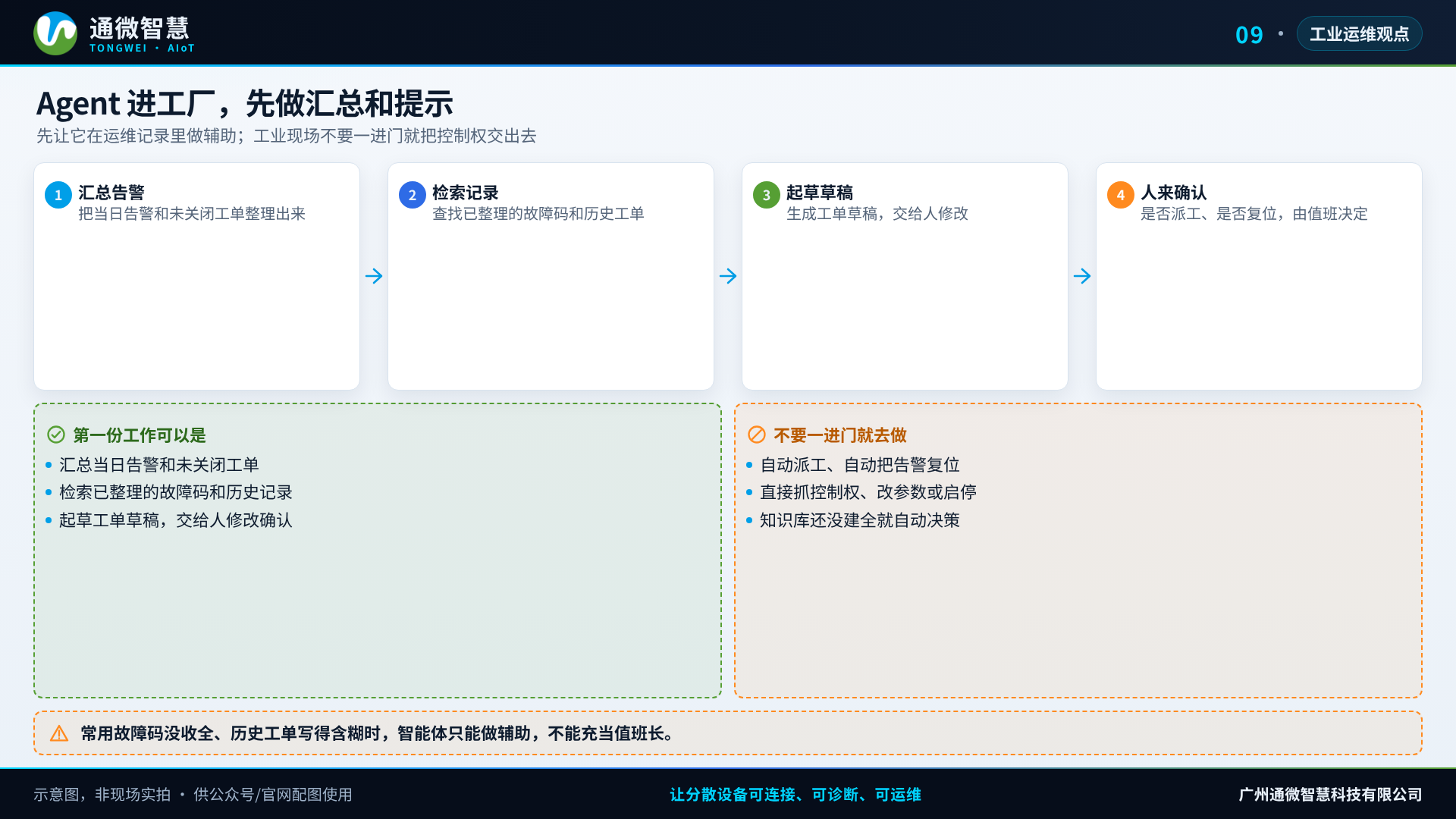
If Tongwei Smart brings an agent into a solution pairing, it usually limits the agent's first job to the following kinds of work.
First, help the duty operator sort the alarms. Gather the messages over a period by equipment, by site, and by a possible parent event, and point out which ones may be the same matter and which ones need to be looked at on their own. The sorted result has to open back into the original records, so a person can check it. It cannot stop at a single summary sentence.
Second, offer a handling suggestion against the knowledge base. The suggestion comes from closed work orders and entries that have been confirmed, and it names the source. Anything without a source can only be raised as a question for reference. It cannot be written as "the root cause is already determined". Whether a person adopts it or rejects it has to leave a record, so that later it is possible to see whether the suggestion actually helped.
Third, help draft a work order and a shift report. The fields come from the alarm and the ledger. A person edits the description and then submits it. The agent can cut down the copying. It cannot stand in for acknowledgement, or for the confirmation that closes the order.
Fourth, answer "what happened to this equipment last time". That requires a clear object ledger and a history that can be retrieved. When it cannot answer, it has to say plainly that the material is not enough, rather than composing an account that sounds complete.
All four can be accepted in a pilot. Take one week of real alarms and see whether the sorting can be traced back, whether a suggestion carries its source, whether the draft leaves fewer blank fields, and whether the answers agree with the ledger. What an industrial-grade AIoT delivers at this stage is an assisting capability, and acceptance follows that. It is not accepted as "it can already run operations on its own".
The smart IoT gateway and the platform have to have the data, the alarms, and the work orders ready before the agent has anything to read. That order cannot be reversed. If remote control and automatic execution are to be discussed, permission, audit, and the safety boundary have to be assessed on their own. They are not part of the first job by default.
A pilot should also set a human review post. The agent's output goes to pending review first, and it enters a formal work order or a notification only after the person on duty confirms it. At the beginning, all of it can be reviewed. Once it is stable, it can be discussed which low-risk outputs need less review. Review is not an extra step. At this stage it is the only way to keep a record of what was right and what was wrong.
What cannot be written into the acceptance of the first stage
Tongwei Smart does not treat automatic diagnosis with a guaranteed accuracy, automatic decisions, automatic remote control, or predictive maintenance as the default scope when an agent goes live. Without enough accumulated data, fault labels, and records a person has confirmed, these capabilities have nothing to be accepted against. Whether the data may be used to train a model, and how it is isolated and authorised, also has to be confirmed separately. It cannot be taken across projects by default.
How it is deployed, the range of interfaces, notification cost, and how responsibility is divided are confirmed per project. An action that involves production safety or personal safety has to stay inside the existing control and the site procedure. An agent may remind. It may not cross these boundaries.
If an agent is being considered, spread the material out and look at it first
If the team is discussing an AI agent entering the plant, book a 20-minute requirements diagnosis. Bring current alarm samples, the work-order records, and the knowledge material that already exists. First see whether it is enough to support assisting work, then decide whether the first task is sorting alarms, retrieving history, or drafting a shift report. The right to execute can be discussed later. It does not have to be in the first conversation.