
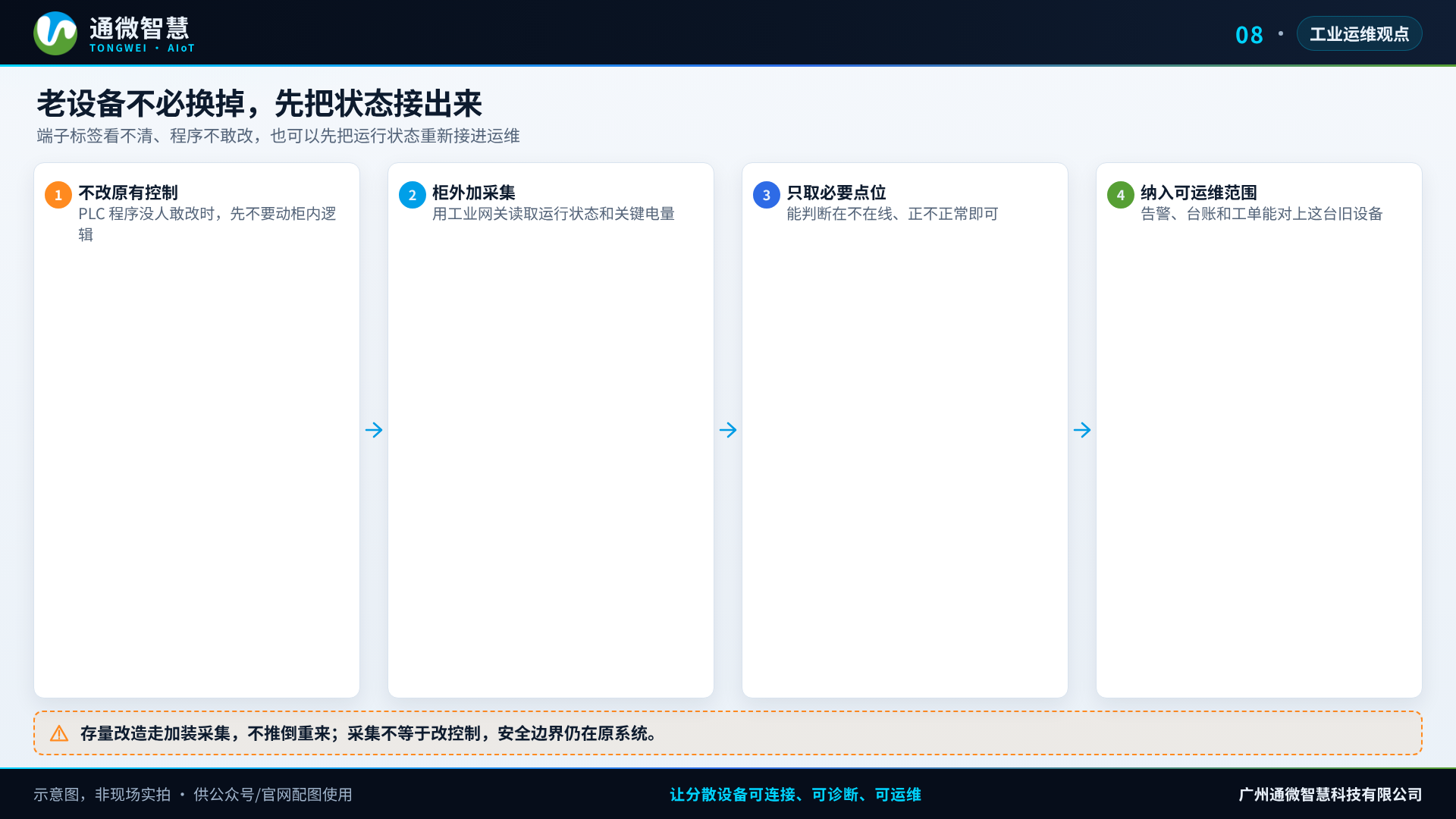
The cabinet has been in service for quite a few years. Nobody dares to change the PLC program, and the terminal labels are almost unreadable. To connect it, acquisition has to be added outside the cabinet first, so the running status and the electrical quantities can be read out. When Guangzhou Tongwei Smart Technology Co., Ltd. (Tongwei Smart) retrofits existing equipment for the IoT, this is the path it takes: do not pull it down and start again. Use an industrial-grade AIoT to bring the old equipment back into a range that can be operated.
The real obstacle with old equipment is often not that it is too old
Many sites are not short of a communications port. They do not dare to touch it. The program has sat for years with nobody keeping a backup, and changing one line risks stopping production. The maker is no longer there, and the manual does not line up with the point list. Extra wires have been added inside the cabinet, and the drawing is still the old revision. So the equipment keeps running. Its status is glanced at only during an inspection, and people gather around it only after something has already gone wrong.
Even with a communications port, onboarding still stumbles. The register table does not match the hardware. The baud rate was changed and never written down. The RS485 bus already carries other meters, and adding one more makes it work and then fail. Some equipment can only put out a dry contact or a current signal, so even reading one run bit needs another module. None of this is a reason to tear the system down and rebuild it. It is a workload that has to be faced.
There are management worries as well. The person responsible for production worries that connecting the equipment will affect control. The person responsible for information systems worries that the data will not come out. Operations hopes at least to look remotely and see whether it is still turning. If the three sides do not have a low-risk way to start, the project stays in discussion. Old equipment is left outside digitalisation not because it has no value, but because the retrofit path sounds too much like replacing the system.
Spare parts and after-sales are affected in the same way. A fault on old equipment is judged by experience, by listening and by watching the meters, and it cannot be described clearly from a distance. If the maker is still providing service, the only option is to send someone to site. The older the equipment, the more it needs to be seen, and it is exactly this equipment that most often stays unseen.
Replacing the controller at the start puts the risk in the retrofit window
Some proposals suggest replacing the old control with a new system and doing the connection at the same time. As a function, that makes sense. The window for doing it is hard to find: production has to stop, the logic has to be written again, and the safety-related functions have to be accepted again. Many sites cannot get past that gate, so the whole matter is put aside.
Adding only a local recorder is not enough either. The data stays inside the cabinet. After a shift change it cannot be seen, and across many sites it is out of the question. What is needed is a method that does not change who is responsible for the original control, can still send the status out, and tries not to lose a key event when the network fluctuates.
Take the status out beside the cabinet, and bring the old equipment into operations
For existing equipment, Tongwei Smart more often follows the standard product pairing: a gateway and expansion modules do the acquisition on a bypass, and they do not replace the original controller.
Start with one identification on site. What signals this equipment can put out, whether the communications port is still there, whether a point list can be found, and whether the power supply and the mounting position allow another device to be added. The result is written as a list: what can be read directly, what needs a module added, and what is not ready yet. What is not ready is marked as pending. It is not forced onto the list to make the list look complete.
Where a bus is available, an industrial gateway reads status, electrical quantity, or a fault bit from the point list. Where only a contact or an analogue value comes out, an expansion module converts it into a point that can be acquired. Whether it is mounted on a rail inside the cabinet or outside the cabinet depends on space, temperature rise, and how people maintain it, so that convenient wiring does not block the original operation. The original control circuit stays as it is. A failure of acquisition should not affect the equipment's own start and stop.
Get the points right before trying to get more of them. Run, fault, and a key temperature or current, the points that can steadily show whether the equipment is normal, come first. Process detail and registers that have not been used can wait for a second batch. Commissioning checks one real action on site: start, stop, and fault reset, to see whether the change on the platform is the same event.
These points then go into alarms and into after-sales or the operations process. Old equipment also needs an offline reminder, an exception reminder, and a handling record. Remote access is read-only first. At this stage the job of an industrial-grade AIoT platform is to make the old equipment appear on the same ledger, not to give it a complicated prediction model straight away. Whether an IoT retrofit has succeeded is judged by whether the status can keep being seen and whether an exception can be handled, not by how many new controllers were swapped in.
If there is another batch of the same old model, the point list and the mounting method already checked on the prototype can be copied. Wiring and addresses still have to be sampled. It cannot be assumed that the inside of every cabinet is the same. On old sites, the share of cabinets whose wiring has been changed is often higher than expected.
When checking that the original control is not affected, the actions have to be real ones. Power the acquisition module on, power it off, break communications, and restore them, and each time watch whether the equipment's own start, stop, and protection still follow the original logic. The platform should report offline when it is offline, but a pump, a fan, or a switch inside the cabinet must not move because acquisition was interrupted. Power should be independent, or taken from a point that has been named. Do not tap the original control circuit wherever a wire happens to be free. When there is not enough space in the cabinet, an external box is better than crowding wires onto the original terminals and leaving a hazard for the next maintenance job. These checks belong in the acceptance. They cannot rest on someone saying that it is a bypass, so it will not affect anything.
Draw the retrofit window and the responsibility before the work starts
Tongwei Smart does not rebuild the customer's core control, and it does not replace safety protection and interlock. Whether the add-on work needs a shutdown, who does the installation, and how to accept that acquisition does not affect the original control should be written into the project. Deployment, data ownership, whether remote control is opened, interfaces, and cost are confirmed per project.
Offline cache and local interlock are implemented as configured. The network in an old station room is generally worse. Acceptance should include one interruption check, to see whether the key events can be filled in after the link comes back. What cannot be filled in has to be stated in the solution, so that later nobody treats a complete curve as something that was promised.
A prototype can start from one typical old cabinet
If there is a batch of equipment that is still in service and has never been brought into remote view, apply for a prototype test first. Pick one machine whose point list can still be found, or at least whose key signals can be confirmed, run bypass acquisition and read-only monitoring through, and then decide how to copy the same model. Checking that it can be seen, and that the original control is not affected, is closer to a first step the site can accept than a discussion of replacing everything.