
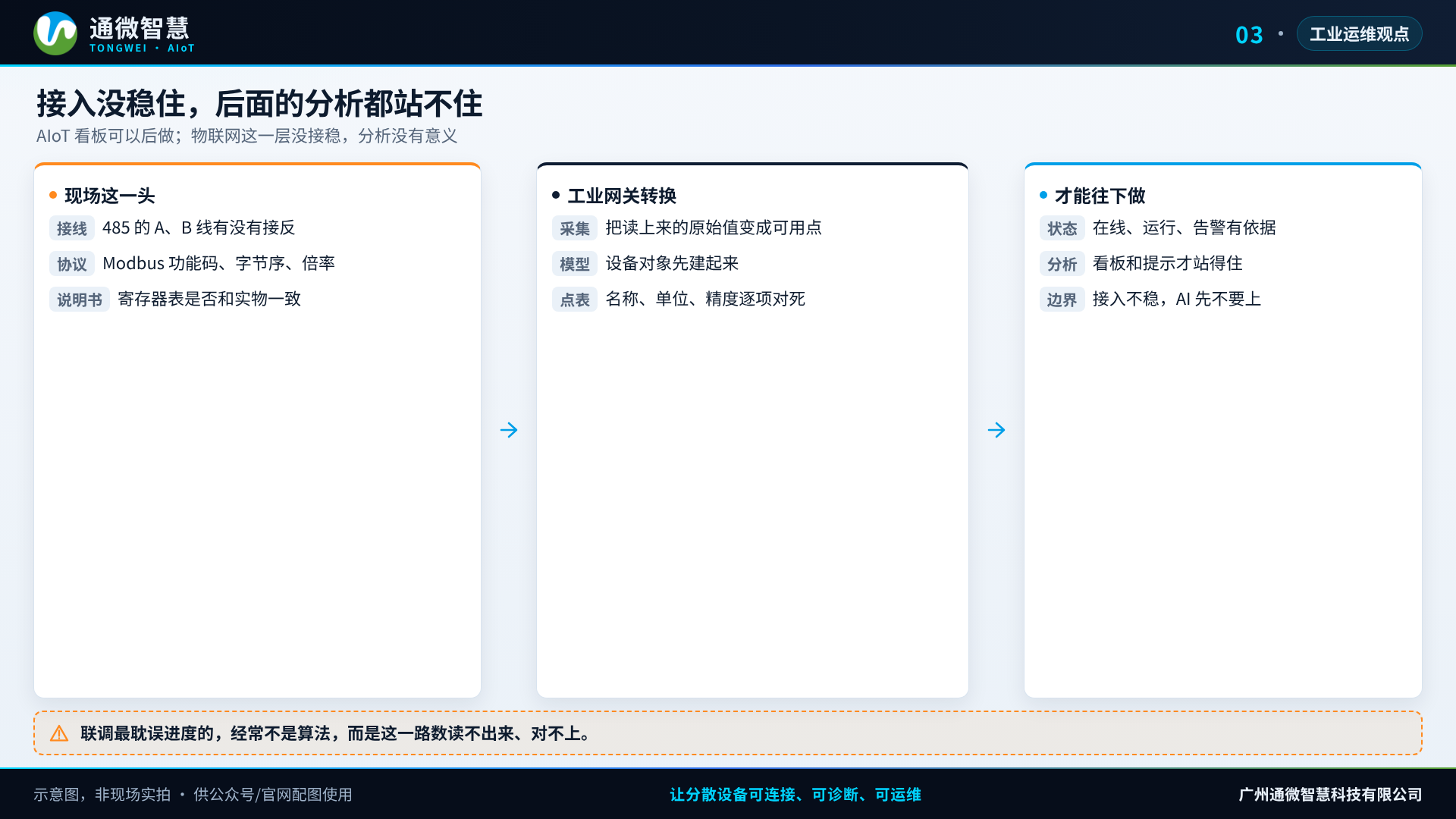
What most often holds up commissioning is not the algorithm. It is that this RS485 line still will not read. A and B are reversed, or the register table does not match the manual. On industrial data-onboarding sites, Guangzhou Tongwei Smart Technology Co., Ltd. (Tongwei Smart) keeps meeting the same sentence: the AIoT dashboard can come later. If the IoT layer is not connected solidly, the analysis after it cannot stand.
Onboarding is hard because the site is not a laboratory
The point list on the drawing is usually clean. Inside the cabinet, it splits into detail. Some equipment is Modbus RTU. Some has already been changed to TCP. Some only provides dry contacts and analogue values. Firmware of the same brand from different years does not necessarily use the same function code and byte order. The manual says 03, and in practice 04 is what reads. The multiplier is in a note on another page and is easy to miss the first time.
Wiring tests people in the same way. RS485 reversed is common. The shield bonded at one end only, two devices with the same address, and a missing termination resistor all make the bus work and then fail. It tests through in the afternoon, then drops packets at night when it is damp or the interference is higher. This does not show up in a meeting room. It is located on site with a multimeter and the frames.
Confused names also consume time, only less visibly. The same point is "incoming A-phase current" on the electrical drawing, "Ia1" in the program, and "cabinet 1 current" on the operations sheet. The person who matched them once still remembers the correspondence. After a change of people, the platform grows duplicate points, empty points, and points assigned to the wrong object. The data looks as if it is running. When it is used, it does not match.
There is also schedule pressure. To catch a demonstration, someone sends up the few points that can be read and says the rest will be filled in later. Later often never fills them in. The gap stays until the alarm and report stage. Checking it then costs more than checking it during commissioning.
Writing the protocol from zero on every project cannot be copied
The traditional method is to have someone write one acquisition program for this project, then write another when the next project changes the equipment. It can be handed over at the time, and little accumulates. If the protocol template, the equipment model, and the point-list version are not kept, every new model the maker adds goes through the same investigation again.
Sending the raw frames upward is not enough either. Without a unified equipment model, the platform sees a pile of addresses and values and cannot turn them into alarms and work orders. Clocks out of sync, acquisition intervals that stretch and shrink, and failures filled with 0 make the later curves hard to look at and hard to use. The aim of onboarding is an operable point, not "there is a number".
Putting hope on "once AI is in, it will recognise the points automatically" is not realistic at this stage. A model can help check a manual against a point list. Wiring, addresses, and multipliers still have to be confirmed by a person on site or in the lab. Reverse the order, and wrong numbers simply arrive faster.
Some people want to skip the site gateway and have each device push its numbers straight to the cloud. When there are few devices, one protocol, and a stable network, it can occasionally be done. As soon as the site has several buses, signals that must be judged locally first, or a network that drops, this method falls apart. Each side writes its own frame format, and after a disconnect it is unclear who caches and who backfills. Putting the onboarding layer close to the equipment keeps the problem inside the cabinet, where it can be closed.
Modbus reads registers. MQTT uses topics and payloads. One looks "old" and the other "new", and the difficulty is similar: field meaning, unit, update rate, and how a failure is represented all have to be agreed. Saying only "we support MQTT", without an equipment model and a point list, still will not match later.
Fix what can be copied, and write down what is still uncertain
In the standard-product pairing, what Tongwei Smart does first is to make onboarding repeatable work, rather than inventing it from zero at every site.
Step one is an equipment list and a point-list assessment. What can come out of a communications port is onboarded by a smart IoT gateway according to the protocol. What can only come out as a switch or 4–20 mA is converted into an acquirable point by an expansion module first. The assessment writes down which points are confirmed, which are pending, and which are not included for now. Do not add a batch of "while we are here" points outside the list with no acceptance standard.
Step two is to keep verified models in an equipment model and a protocol template. When the same series comes on again, the registers and multipliers already checked should be reused, and only the differences handled. The commissioning record keeps the function code, start address, byte order, acquisition interval, and how a failure is retried. That is more useful than saying "it has been checked".
Step three is to manage data quality from the moment of onboarding. Offline is marked offline. It is not impersonated with 0. The timestamp uses the time after the clock has been set. Key points have a reasonable-range check. A value that has clearly flown off is isolated first, then the site is checked. Offline cache and backfill after recovery are implemented as configured. If they are configured, acceptance includes one link-loss drill, to see whether the curve loses a stretch and whether it can be filled after the link returns.
Step four closes names and the ledger together. One point has one formal name. The drawing name and the program name are kept as aliases, but the primary name must be unified. Later alarms, work orders, and reports then speak about the same thing. An industrial-grade AIoT platform can use these points only if the names and units are aligned first.
Step five accepts onboarding by whether it can support operations, not by how many protocols were connected. It passes when the agreed points can be read steadily and a status change is reflected in an alarm. A long list of protocols is not the score. Stable and usable is. On commissioning day, bring the point list, the wiring notes, and a computer that can capture frames, and confirm point by point. Do not only look at "there is a number" on the platform. Between a number and a correct number there are still several steps.
Onboarding has a boundary. It cannot be written as connecting anything
Tongwei Smart does not promise that any brand and any model can be plugged in and used. Whether it can be onboarded is judged from the equipment list, the protocol, and the point list. What cannot be assessed is marked as pending. The gateway does not replace the site's existing controller and safety system. It acquires, converts, and uploads. It does not take over the protection logic.
Whether it is deployed on the customer's platform or on Tongwei's side, how interfaces are opened, who the data belongs to, and whether remote control is opened are confirmed per project. Uploading to several centres at once, and local interlock, are also implemented as configured. When MES, ERP, or the maker's own system must be connected, fields and frequency are agreed separately. "There is an API, so it will connect at once" is not the default.
Commissioning can start from a selection list
If a product line or a site is stuck on onboarding, start with a selection list. Send the equipment models, the communications method, and the point list that already exists, and first confirm which items can be configured directly and which need a prototype commissioning. Once that layer is clear, alarms and diagnosis have a base. The selection list does not have to be complete in one pass. Circling the models and the point range that are going online now is enough.