
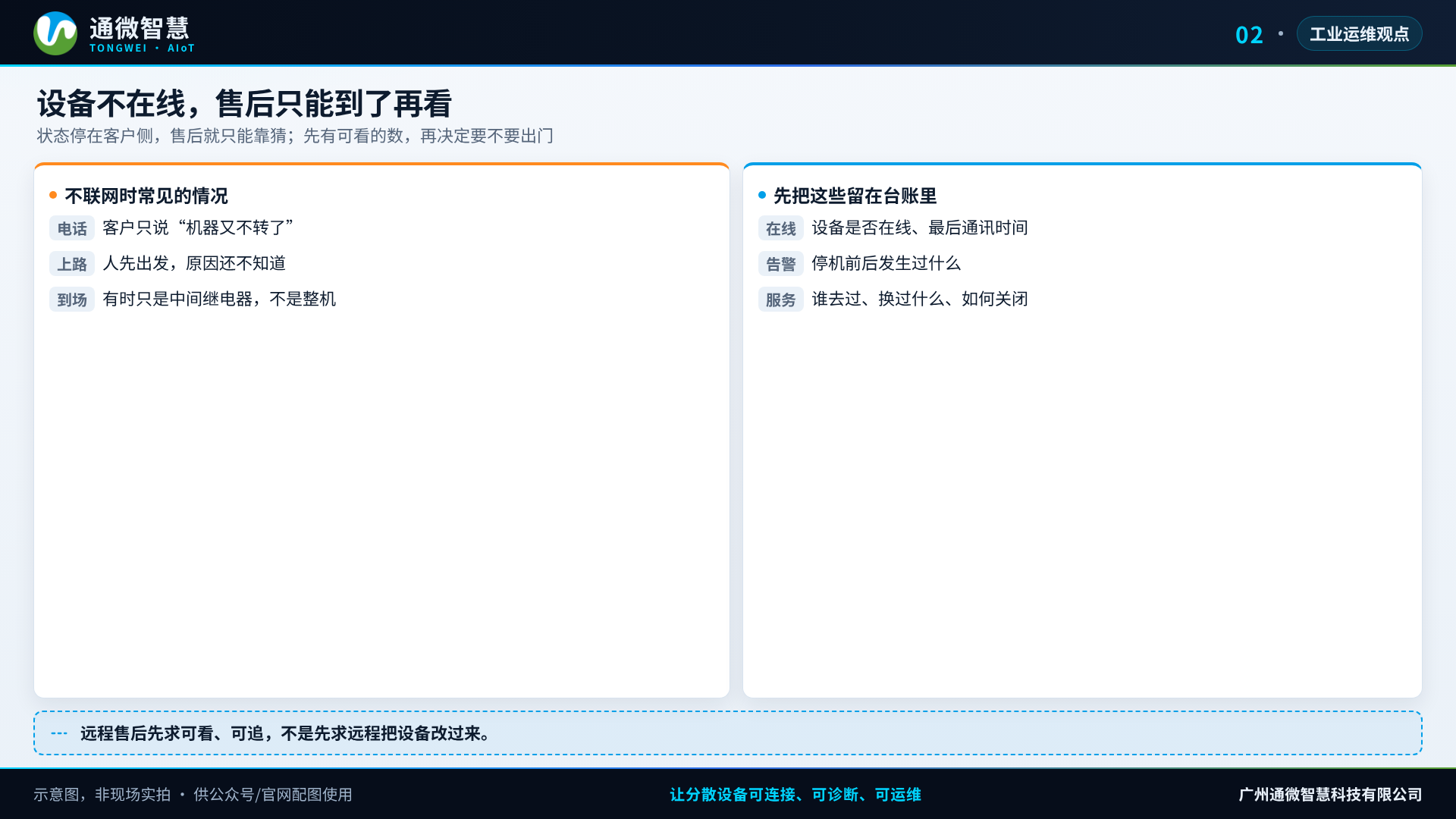
The customer says only "the machine has stopped again", and after-sales is already on the road. After a two-hour drive, the fault turns out to be an intermediate relay, not a failure of the whole machine. When Guangzhou Tongwei Smart Technology Co., Ltd. (Tongwei Smart) fits IoT to equipment, this is not rare. Once the machine leaves the factory, its status stays on the customer's side. Industrial-grade AIoT needs numbers that can be seen before after-sales can stop guessing.
What consumes the time is often not the repair itself
Before shipment, the equipment can be seen, measured, and reproduced in the workshop. After it reaches the customer's site, the information channel narrows at once. The customer's description is incomplete, a photo does not show the terminal strip clearly, and a fault code flashed and was not written down. After-sales has to ask first: did a breaker trip, was there an unusual sound, were parameters changed recently? The finer the questions, the less patient the other side becomes, and someone is still sent.
The hours on the road are the most passive. Sometimes the supply breaker has tripped. Sometimes a sensor has come loose. Sometimes the parameters were changed once on site. If running status, the fault word, and the latest few state changes could be seen before leaving, many trips would not have to start at once, or the right spare could be taken. What happens now is common: the vehicle has already left, and the spare parts in the case still cover "several possibilities".
Service records also scatter. The repair is written in a personal notebook, or a group chat gets one line saying "it's fine" and that is the end. The next report is taken by someone else, who asks from zero again. Serial number, factory configuration, and the module replaced last time do not match up. When the maker wants to count which class of fault costs the most people and the most travel, the month-end job is to go through chat logs and expense claims.
Another case is more of a waste. The equipment actually has a communications port, but it was not connected to a path that can be reached remotely when it left the factory. The cabinet door closes, RS485 is left empty, the Ethernet port is not configured, and no place was reserved for a 4G antenna. After-sales is working blind. It is not that it cannot be connected. Networking was not treated as part of the product at the start.
Sending more experienced people runs out once the sites spread
Many makers cope by sending more experienced people and coaching the customer by phone. When sites are nearby and the volume is small, that can still turn. After the equipment spreads, there are not enough experienced people to go around. A newer person arrives on site and still photographs the panel and waits for instructions. Travel and time are spent confirming the problem. The time actually spent taking the machine apart is short. The customer feels the response is slow. The maker feels the person is already on the road.
Putting together a remote desktop or a port mapping in a hurry looks like a connection, and the risk is greater. How accounts are managed, who can change parameters, and whether a change is recorded are often not designed in time. When something goes wrong, it is unclear whether the site touched it or a remote session changed it. This kind of method only solves "it can connect". It does not solve "it can be judged, it can leave a record, and the permissions can be held".
Phone coaching also has a limit. The person on the other end is not an electrician. Ask them to read a register or a fault word, and what they read back may not be what is there. Without a status page that can be matched at a glance, remote coordination becomes the two sides guessing at each other.
Let the equipment be seen first, then talk about after-sales coordination
What Tongwei Smart builds for equipment makers is a standard-product pairing: without rebuilding the core controller, add connectivity, status acquisition, alarms, and after-sales work orders.
First confirm what the equipment can provide. Fault codes, running status, and key electrical or process values that can come out of a communications port are onboarded by an industrial gateway against the point list. What can only come out as a dry contact or 4–20 mA is turned into an acquirable point by an expansion module first. Protocol, registers, and multipliers follow the commissioning result, not an assumption from the manual. Points that do not match the list are marked. Usable points are used first. Uncertain numbers are not sent up just for a demonstration.
Next, turn online, offline, fault, and out-of-limit into signals after-sales can use. An alarm goes to a specific responsible person and carries the equipment number and a key snapshot, rather than only the sentence "equipment abnormal". The first remote stage is read-only: look at the curve, the fault word, and the latest state changes, and use them to judge whether to send someone and what to take. Once read-only is stable, discuss by equipment type which points may be opened for control.
Then write each service visit into a ledger. Where the report came from, how it was judged remotely, whether someone went on site, what was replaced, and on what cause it was closed are all kept. The next person who meets the same fault can pick it up. The maker can also see which problems repeat, and whether they are design, installation, or use.
If it is also to become the maker's own service brand, the login page, account system, and interfaces can be assessed as OEM. The steadier path is to pick one product line with large shipments and relatively clear communications, run a prototype through, then copy it to the same series. Requiring "every model covered" from the start stretches commissioning.
The value of industrial-grade AIoT at this step is to move after-sales from listening to the customer's account to judging against status. A knowledge base and assisting analysis can be added later. The condition is that the equipment is online and the points are trustworthy, and that the IoT path is stable first.
The page after-sales staff can actually use does not have to be complicated. Open it and see whether this machine is online, the current fault word, the time of the latest state change, and a short curve of the key values. It is better if it also brings the factory number and a summary of the last service. Enough information makes the judgment faster. Too much information, poorly sorted, is what the duty shift does not look at.
Prototype tests should also be designed around the after-sales scene, not only around "how many registers can be read". Simulate one offline event, one fault word appearing, and one out-of-limit recovery. See whether the alarm reaches a person, whether read-only remote access is enough to judge, and whether a work order can be created from that alarm and closed. Once those pass, discuss how the gateway is preinstalled for batch shipment and how the antenna and communications card travel with the equipment. That avoids a lot of rework.
What cannot be assumed to be already in place
Tongwei Smart does not replace the equipment's original controller or its safety protection. If remote control is to be opened, it must have layered authorization and auditable operations, and the responsibility relative to the original system must be written down. "Connected, so it can be changed" cannot be the default. Which models can be connected and which points can be acquired are assessed against the equipment list, the protocol, and the point list. What cannot be connected is not written into a promise.
Deployment method, where the data sits, how it connects to the maker's existing service system, and traffic and notification costs are confirmed per project. Offline cache, multi-centre upload, and similar capabilities are implemented as configured. What the scheme does not include is not accepted as already provided. The prototype and the commissioning scope should also be written down in advance, so that one test is not taken to mean every model has been verified.
It can start from one prototype
If the after-sales team is already being worn down by "finding the cause only after arriving", apply for a prototype test first. Pick a model with large shipments and relatively clear communications, run status acquisition and read-only remote access through, then decide whether to extend it to control coordination and an after-sales ledger. Bring the equipment model, the communications ports it already has, and the faults after-sales most often misjudges. Commissioning will be more to the point.