
In an existing equipment room, the UPS communications card can already read input, output, and total battery voltage, while the retrofit request says locate the abnormal battery. The gap between the two is cell-by-cell detection data. When Guangzhou Tongwei Smart Technology Co., Ltd. (Tongwei Smart) pairs standard products for equipment IoT and AIoT, it usually compares the equipment list with the point list first, then decides which devices the gateway reads and which data need extra detection on site.
Choose one of three access paths from the data that is missing
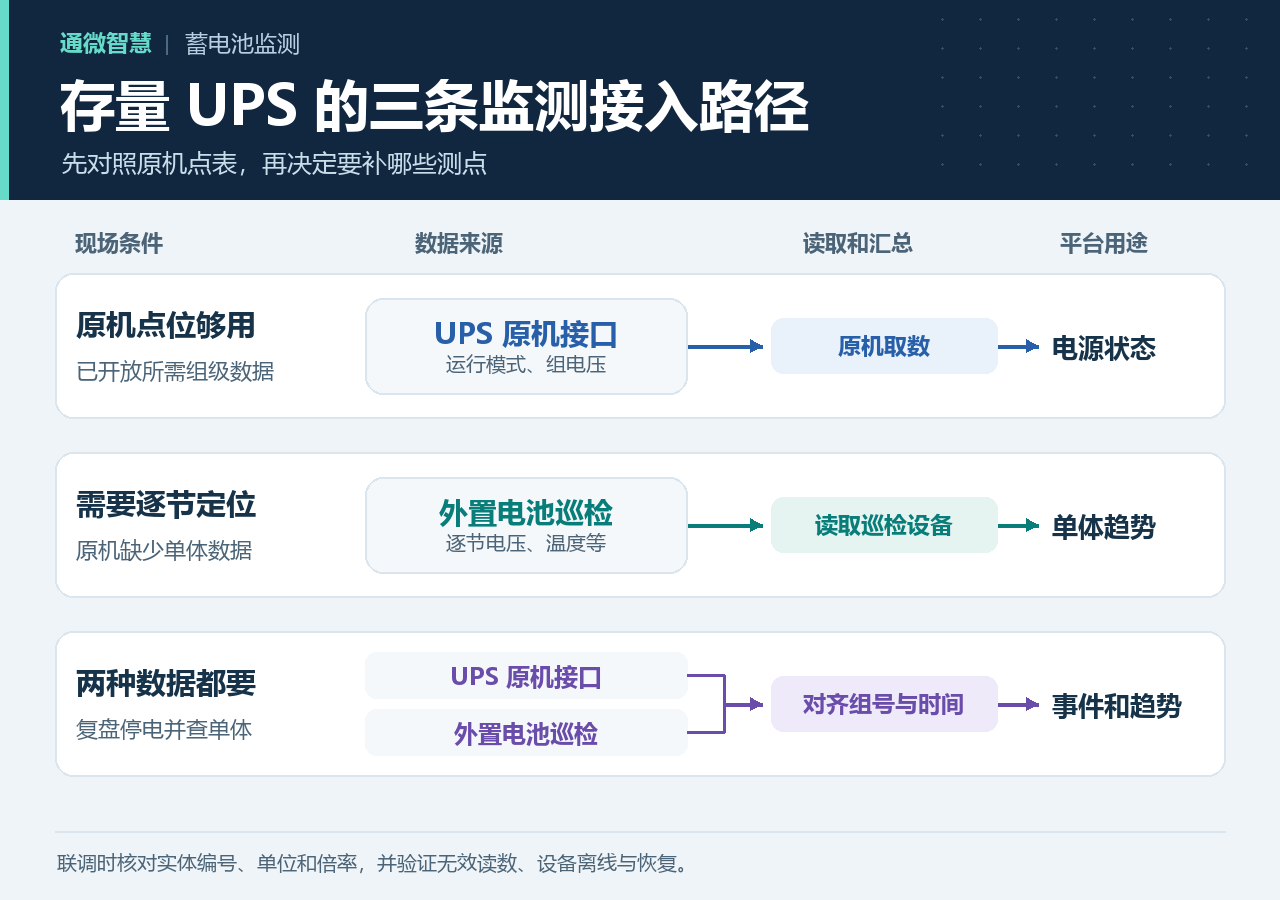
| What the site already has | Access path | What to verify first |
|---|---|---|
| The UPS already exposes the string-level data needed, and the goal is power status and battery takeover | Read through the original interface | Model, communications card, protocol version, status enumerations, addresses that can actually be read |
| The original unit lacks cell voltage, temperature, or internal resistance, and the site needs to locate an abnormal cell | Add an external battery detector and connect it according to its capability | Battery type and string layout, point granularity, detection method, and the manufacturer's conditions of use |
| Both the UPS event and the change on each cell need to be reviewed | Connect the UPS and the inspection device to the same site | The relationship between that UPS and its battery string, the time of each data set, the alarm source, and the offline status of the device |
The manufacturer's register table should be checked against the point list of the actual unit. UPS units in the same series can carry different communications cards or firmware. Two fields can both be called battery status, while one is an operating mode and the other is a battery-alarm flag. The site can start from read-only status, read points that can be checked such as voltage and operating mode, and compare them with the local panel or an existing record.
A small battery string can also be assessed for reuse of the existing gateway
On a site with only two or four cells in each string, if a serial port is already available, the agreed protocol is supported, and a point list can be configured, one detector per string can be assessed, with the existing industrial gateway reading the cell data directly. The Tongwei Smart small-string arrangement takes voltage, temperature, and channel data status as the base design. Internal resistance is an option that has to be verified on a sample unit. Communications and isolation are confirmed from the battery string and the site conditions. The acquisition device measures. The gateway polls and uploads against the point list. The platform displays and alarms.
If the external detector on site uses a dedicated interface and the manufacturer requires a matching host to gather it, check the external interface of that system first. The project list should state at least four things: the UPS model and the original point list, the number of strings and the series-parallel relationship, whether string-level or cell-level data is required, and the possible window for installation and commissioning. Installation of the detection equipment and the electrical tests on site are organised by the owner or the integrator, and carried out by qualified staff under the applicable procedure.
Acceptance has to recognise the reading, the number, and the exception status
Split the acceptance sheet into three groups. First match the physical cabinet number, the battery string number, and the cell number to the platform mapping. Then check the register data type, scale, unit, sign, and reading range. Last, use an approved commissioning case to check communications loss, acquisition recovery, and the alarm record. Not opened, not acquired, an invalid reading, and the last valid value should be shown separately, so the duty operator can tell a battery exception from an IoT acquisition exception.
What the AIoT platform receives is a point with a clear source. An integrator can hand the UPS nameplate, the communications accessories, and the battery-string configuration to Tongwei Smart, build one sample point list first, and then decide whether to use the existing platform, a paired gateway, or added external acquisition.