
The string voltage of a UPS battery can sit close to its usual value while one cell drops first after the load is taken over. Series string voltage reflects the overall level of the cell terminal voltages. Finding which cell is behaving differently still requires the reading from each cell. When Guangzhou Tongwei Smart Technology Co., Ltd. (Tongwei Smart) connects UPS batteries to the IoT and analyses AIoT trends, it first has the operations team separate which object each sensor is measuring.
How to use each of the three readings
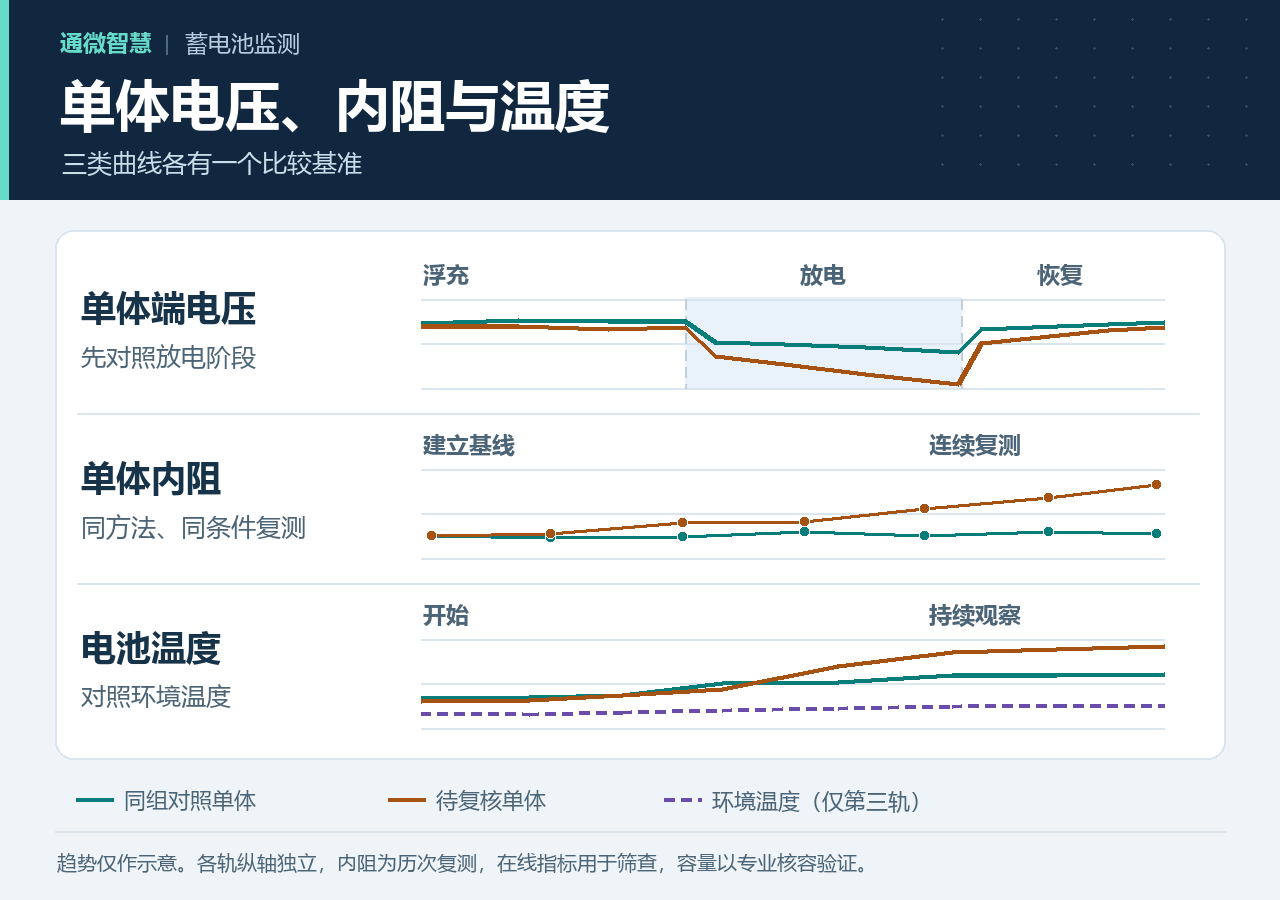
| Online point | Where to look for a clue | What to record with it |
|---|---|---|
| Cell terminal voltage | An outlier in the same string under the same condition, and a cell that falls faster during discharge | Operating mode, discharge current, the start and end of the interval, cell number |
| Internal resistance or conductance | A long-term change on the same instrument and method, and a sustained departure inside a string of the same rating | Instrument and method, contact condition, temperature at the test, and battery operating condition |
| Temperature at the battery point | A sustained rise on one cell or in one area, or a whole row following the ambient temperature | Ambient temperature, sensor location, charge and discharge current, time |
Float-charge data is suited to differences inside the same string and to long-term change. During a discharge, string current and each cell voltage can be placed on the same time axis, to find the cell whose voltage drops further and recovers differently at a similar current. Parallel strings should be checked against their own branch current first, so strings under different load conditions are not compared directly.
Internal resistance is better used to follow a trend
Detectors can use different excitation and algorithms, so internal resistance, conductance, and impedance should be read according to the instrument definition and the manufacturer's requirements. The first time a cell reading rises, check the sampling contact, the measurement method, and the operating condition, then repeat the test with the same method. A clearer direction for an on-site check appears when the same cell number keeps departing across several comparisons and also behaves abnormally during discharge.
Temperature also depends on where it is sampled. A room temperature and humidity probe reads the environment. A probe on the battery surface or on a terminal reads a local point. If a whole row warms together, compare the air-conditioning status and the ambient probe first. A local heat exception should be recorded with the time, the neighbouring cells, and the charge or discharge current at that moment, and handed to site maintenance. A sampling lead that has come off, or a probe that has failed, should be recorded separately as a data exception.
A capacity test answers how much capacity the battery can deliver
Under the applicable battery manufacturer's procedure and a plan approved for the site, qualified staff obtain a capacity result under stated conditions through a controlled discharge test. The report should keep the discharge current or power, the temperature, the end condition, and the test date. Data from a short outage is suited to reviewing that takeover. The capacity record should cite a test report that meets the requirement. If an online system shows SOC or SOH, it should also state which device it comes from and which assessment basis was used.
After these data are brought in through an industrial gateway, the AIoT platform can be configured for three uses: comparison inside the same string, trend review, and exception notification. A Tongwei Smart solution pairing is suited to checking points on one string first. Put the battery list, the inspection sheet, and the latest test report together, and confirm which cell and which operating condition each IoT curve belongs to. Later alarms can then be assigned to a specific person.