
On the daily round of a power distribution room, the DC bus voltage is always inside the range. Only when the battery is actually needed does it become clear that this one daily reading cannot show how much load the string carried. Build separate points for the charger, the bus, the battery, and insulation monitoring. When an alarm arrives, it is then clear who should be asked.
Separate the four objects being monitored
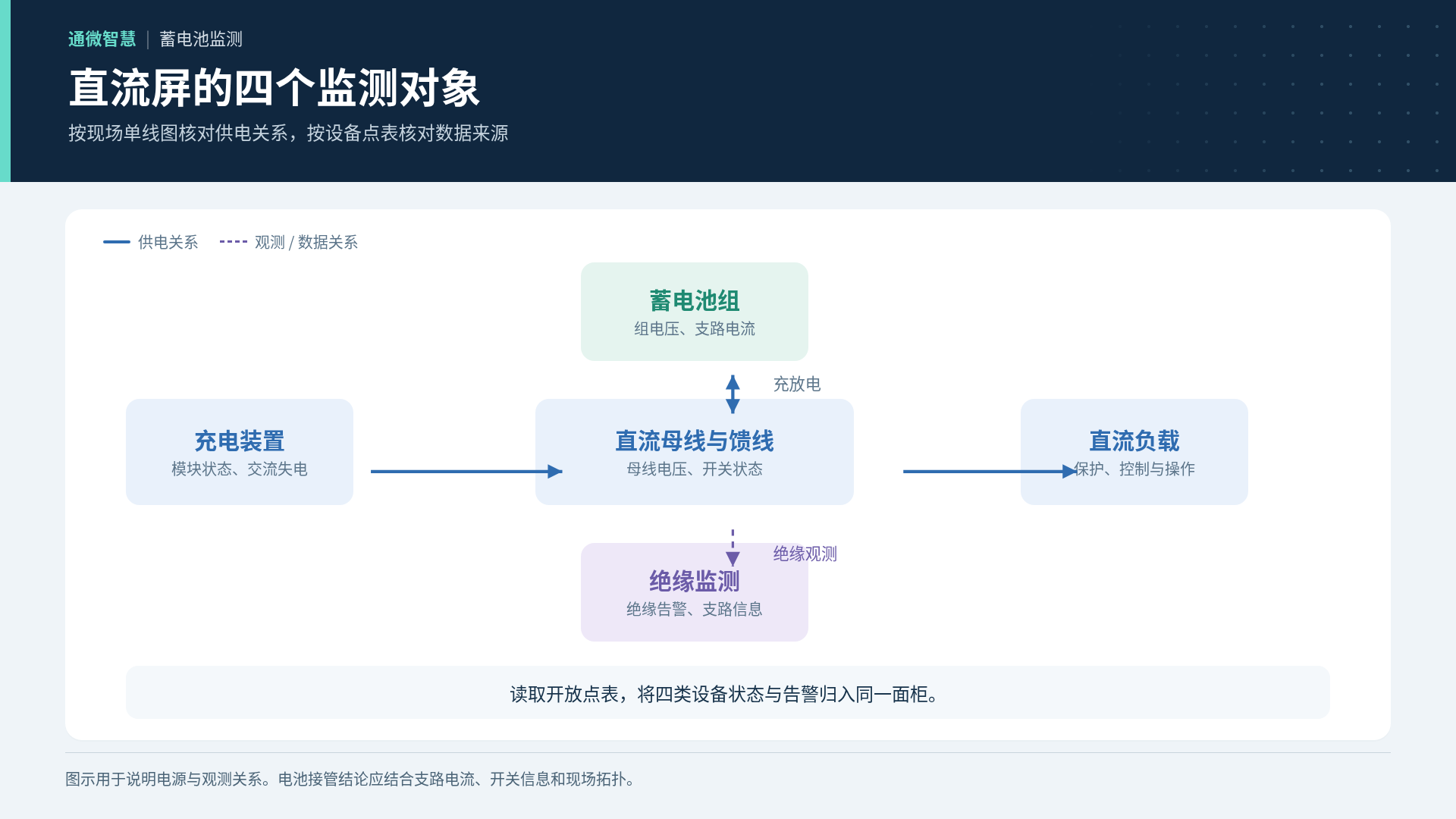
A common station DC system may supply relay protection, circuit-breaker operation, and other DC control loads. The actual loads are on this station's single-line diagram. While the AC supply is normal, the charger maintains the DC supply and charges or float-charges the battery. When the charger loses supply or drops out, and the battery branch is available, the battery string carries the corresponding load. Bus voltage only describes the state of that point at that moment. Whether the battery is connected reliably, and whether it can supply under the stated condition, has to be checked separately.
| Object | Points to compare first | What operations uses it for |
|---|---|---|
| Charger | AC supply loss, module running or fault, charge status | Confirm whether the supply equipment has dropped out, and what is supporting the bus after a fault |
| DC bus and feeders | Bus voltage, and the switch and feeder status the site has made available | Judge which bus section and which supply branches are affected |
| Battery string | Total voltage, branch current and its direction, string switch, and cell data that is available | Identify the string that took part in the discharge, and the cells that need a recheck |
| Insulation monitoring | Insulation alarm, the bus it belongs to, and branch information the device can provide | Give a direction for a professional inspection, and keep the original alarm and the time it occurred |
Put a change in bus voltage back into the supply sequence
When the combination is charger dropped out, bus still at voltage, look at whether the battery branch current has changed from float charge or near zero into discharge, and compare the switch record. If the site has two chargers and two strings, a sectionalised bus, or a tie branch, first confirm which section and which path is supplying. If only one bus voltage is in hand, the event report can state the supply status that was observed. Whether the battery actually took over is left for maintenance to recheck.
An insulation exception and battery capacity are two different problems. When the insulation monitor raises an alarm, keep the device's original record and the branch information, and have qualified staff inspect it under the site procedure. For a string that is normally on float charge, the daily inspection, connection check, and capacity test required by the manufacturer are filed separately, and the conclusion goes back to the same string number. Do not read an insulation alarm as the battery being close to empty.
Finish the data check on one cabinet first
From the single-line diagram, pick one DC panel that already has a communications interface, and list the point list of the charger, the bus section, the battery string, and the insulation monitor. Tongwei Smart can use an industrial gateway to connect the read-only status that is already open onto the platform, and show it by equipment and by supply relationship. Protection and control logic stay with the equipment on site. Replay the historical alarms and the battery maintenance record of one cabinet first, and see whether the duty shift can follow the readings to the equipment, the responsible person, and the branch still to be rechecked.