
A park has several equipment rooms, and the maintenance staff can arrange only one professional capacity test this week. Which string goes first depends on the service it supports, how much exception evidence is already in hand, and whether the site can arrange the test safely. Put the battery trend, the last test, and the on-site handling record in the same file for that string. The schedule then has something to stand on. Online monitoring can help pick the string to look at first. It cannot stand in for a professional capacity test.
Complete three kinds of evidence for each string
The first is the consequence for the supply. Record which service this UPS supports, whether a backup path has already been confirmed as available, and what maintenance window the site can arrange. Two strings can have similar readings. If a critical equipment room loses standby power, the consequence can still be much larger.
The second is a recent exception. A sustained voltage outlier, a temperature exception, a change in the internal-resistance trend, and a clear difference during one discharge should each carry the actual interval and the source of the value. Dozens of alarms that repeat in one period can be gathered into one open item. The original records still have to be kept. The number of alarms is better used to measure the load on the duty shift. How long the exception lasted, and under what operating condition it appeared, is more useful for the investigation.
The third is how complete the records are. Note the dates of commissioning and replacement, the conclusion of the latest inspection and capacity test, the battery layout, the test organisation or the maintenance person, the protected load, and the planned date. The ledger should be able to show no valid record or monitoring offline. An old report should keep the date and the conditions that applied at the time.
Three sites, three open items
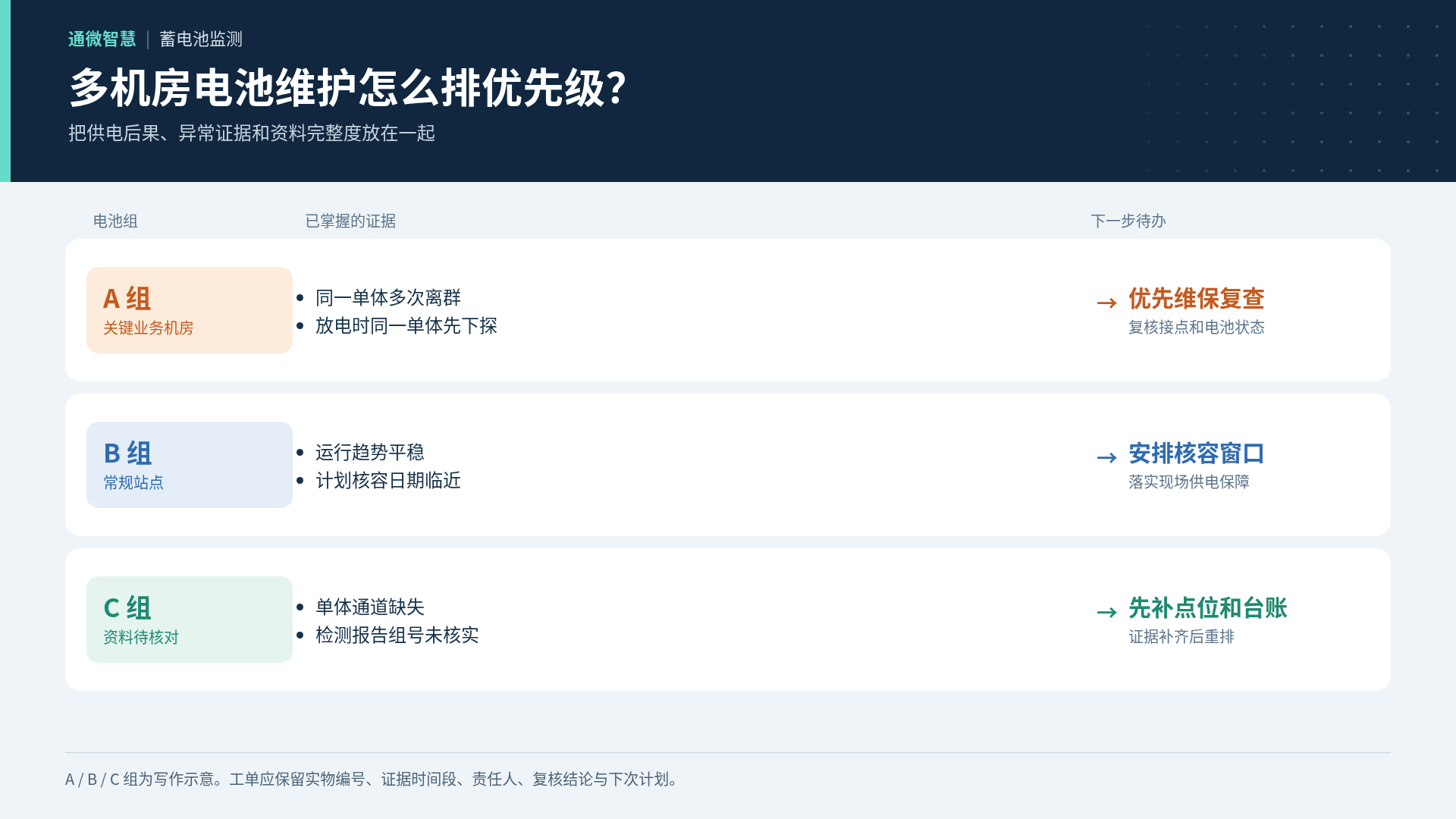
| Example | What is already known | What the schedule does |
|---|---|---|
| String A | A critical equipment room has a repeated cell outlier, and the latest discharge also showed the same cell dropping first | Have maintenance recheck the contact, the test data, and the battery condition first, then arrange a professional test from the result |
| String B | A routine site has a steady trend, and the capacity test is near the date in the site plan | Lock the test window and the safeguards to the plan, and write the result back to the same string |
| String C | The platform shows it online for a long time, but a cell channel is missing, and the string number on the test report cannot be matched | Restore or verify acquisition first, match the device, the physical number, and the report, then reschedule |
The three strings above are an illustration for the article. They are not a real schedule from a site. If a recheck of string A confirms that it was only a sampling-contact fault, the open item should change to an acquisition correction, and the trend after the correction should keep being followed. If the battery is still abnormal after the recheck, maintenance should decide, from the manufacturer's procedure and the site's supply safeguards, whether the next step is a capacity test or a replacement assessment. The arrangement of supply safeguards, a visible abnormality, and the test window is decided by the responsible person on site.
A work order has to connect to the next plan
The work order should keep the person who handled it, the physical number, the interval of the evidence, the professional test report, the review conclusion, and the next plan. After a battery is replaced, the old and new histories stay separate. The trend of a new cell starts from a new baseline. For parallel strings, branch current and the latest discharge condition can also be added to each string, so a later comparison has something to use.
Tongwei Smart can gather the data by site, by UPS, by battery string, and by cell, turn an alarm into an open item, and write the handling conclusion back to the same file. A maintenance lead can start with three sites, turn last month's alarms and the latest test record into one list to be checked, finish the retest, the feedback, and the plan update, and then spread the fields to the other sites.