
At shift change, the night shift left one sentence: "The alarms kept jumping, so I muted them." Open the record and a screen of the same limit breach has piled up within a dozen minutes, and a power-loss message in the middle was almost swept past with them. When Guangzhou Tongwei Smart Technology Co., Ltd. (Tongwei Smart) looks at multi-site operations, it first asks whether anyone has claimed the alarm, and only then whether the IoT and the industrial-grade AIoT are actually smart.
When alarms pile up, the one that matters is the easiest to lose
After many systems go live, the first "result" is that messages increase. Temperature over limit, communications loss, a door left open too long, and level fluctuation all push outward. The duty room never goes quiet, and the phone never stops vibrating. Within a few days people mute the notifications, or only look when someone mentions them in the group. The system is still working. People have started to hide from it.
Repetition is worse. When one smart IoT gateway drops offline, the instruments under it all report offline together, and a long string can jump out in a short time. A level probe jitters once, the pump run signal changes with it, and "over limit", "start", and "stop" take turns. They may point at the same event, yet they fill the screen. If a person clicks them one by one, the shift is spent closing windows. If the whole screen is cleared, the critical line goes with it.
Responsibility is also unclear. An alarm pushed to a public group is seen by everyone, and everyone assumes someone else will look. At the handover between day and night shifts, all that is said is "it kept jumping". Nobody can say which line is still open and which one someone already went on site to check. At the month-end review, what remains is a pile of unclosed records that cannot be matched to the judgement made at the time.
There is also the case of a threshold set too tight. To look "sensitive enough", the limit is pinned at the edge of normal fluctuation. When the weather changes or the process is adjusted, alarms arrive in a dense burst. The team gradually stops trusting these reminders. When a real sustained breach arrives, the response is slower than before.
Sending more messages does not mean operations are more sure
In the old method, a common pattern is to set every signal to the same grade and then add more push channels. SMS, WeChat, and phone calls all go out together, on the assumption that nobody can miss it. The result is that more channels mean faster fatigue. Without grades, there is no difference between "must be handled immediately" and "note it, and look when the shift opens".
Without deduplication and correlation, a root cause is split into many surface symptoms. A gateway power loss, a switch restart, and an upstream outage all look, from the equipment side, like a batch of offline events. If the system cannot gather them into one matter, the duty operator can hardly judge in three minutes which cabinet to go to first.
Without acknowledgement and a close condition, an alarm is only a notice. There is nowhere to write who took it, what was done, and why it can be closed. The next time the same problem appears, people start from zero again. If smart operations stop at this layer, they have only replaced the old telephone repair call with a louder prompt.
Let every valid alarm drive one action
In the solution pairing, Tongwei Smart places alarm management in the middle of the operations loop, rather than treating it as a standalone "messaging system". The method can be gathered into a few lines and verified on one site first.
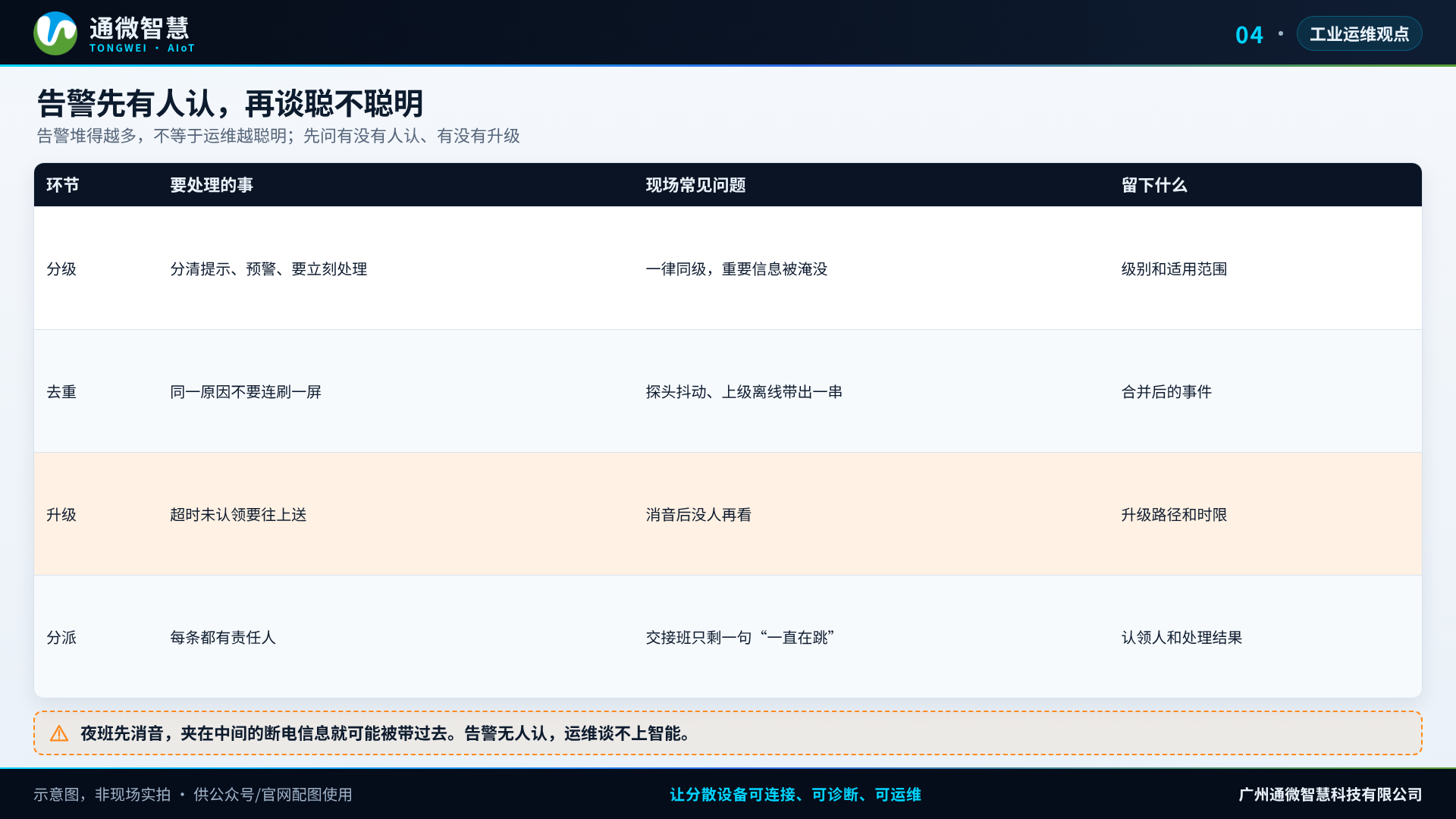
Grade first. What needs an immediate response, what this shift must watch, and what only needs to be recorded are written separately. More grades are not better. Three grades are usually enough. Each grade corresponds to who receives it, by what method, and how long without acknowledgement before it escalates. The escalation target is written to a person and to the relief rule, not to an abstract "duty room".
Then deduplicate and converge. Repeated breaches on the same equipment inside a suppression window should be merged. A batch of offline events caused by the same gateway or the same power feed should be visible as a parent event. The convergence rule must be explainable, so the duty operator knows why twenty lines became one, rather than feeling that the system "ate the alarms".
Then connect the alarm to a work order. A critical grade generates a to-do by default, with the equipment, the site, the trigger value, and the time written clearly. After the site is handled, closing must leave a cause and a photo or a short note. A reset signal can indicate recovery. It cannot automatically equal the end of the event, especially on a point that jitters repeatedly.
Rules also need a regular review. Which alarms were the most this week, which were never handled, and which returned soon after being closed should be visible in a report. Widen a threshold that should be widened, repair a probe that should be repaired, and change logic that should be changed. An industrial-grade AIoT platform can assist with statistics and with pointing out a correlation. The judgement is still made by a person. Adjustments are recorded, so they are not passed by word of mouth and changed back a few months later.
Finally, acceptance does not look at whether the alarm count is high enough. What is more useful is whether a valid alarm can be acknowledged in time, whether the close reason was written, and whether repeat events have fallen. These can be checked against a pilot site.
During the pilot, look at "mute" on its own. If a shift still has to kill the sound with the master switch in order to work, grading has not taken effect, or there are still too many invalid alarms. Go back and change the threshold, the jitter suppression, and the responsible person, rather than adding a louder prompt. The duty roster, the notification method, and the night outbound-call rule are best reviewed together with the alarm policy, so the platform is not changed while the crew still handles things the old way.
The quality of site onboarding also affects whether alarms are trusted. A jittering point, a clock that is off, and a false offline report all push the duty room back to "mute it first". However fine the alarm rules are, they have to stand on stable acquisition. This layer often has to be checked together with the gateway configuration and the point list. It cannot be fixed only by moving limits back and forth on the platform.
Rules cannot be set once and then left alone
An alarm policy depends on site conditions. The thresholds of one site cannot be copied onto every site. Probe range, process setpoints, and the duty roster differ, so the same number does not mean the same thing. The channel used for notification, whether outbound calls are allowed at night, and who may view remotely are confirmed per project.
How alarms are cached during a network break, and how they are backfilled after recovery, is implemented as configured. Acceptance should include one interruption drill. Tongwei Smart does not replace safety systems such as fire alarm, process interlock, and site protection. How those report, and who handles them, still follows their own procedures. The operations platform handles only equipment and environment events inside the agreed range.
Assisted analysis can suggest that "this batch of offline events looks more like a parent-circuit problem". It is not an automatic determination, and it should not close an alarm directly. What has not been confirmed by a person should not be written as a finished diagnosis.
First get one site's alarm account straight
If the biggest trouble now is that there are too many messages and they never land, book a 20-minute requirements diagnosis. Bring one week of alarm records and the duty arrangement, and see which link of grading, deduplication, and work orders is missing in the current process. Run the rules through on one site first, then copy them to the other sites. That is steadier than changing push notifications across the whole network at the start. Real records are more useful than a feature list. What should be merged, what should be escalated, and what should not be reported at all is easier to discuss against a week of data.