
The week the senior technician was on leave, nobody in the duty room could say how the pump at the south site is normally switched. The note on the cabinet door was still handwriting from several years ago. The parameters and the key habits were all in his head. Once sites are scattered, a good memory is not enough. Guangzhou Tongwei Smart Technology Co., Ltd. (Tongwei Smart) does multi-site IoT operations for exactly this: an industrial-grade AIoT first keeps the ledger and the process, so people can rotate.
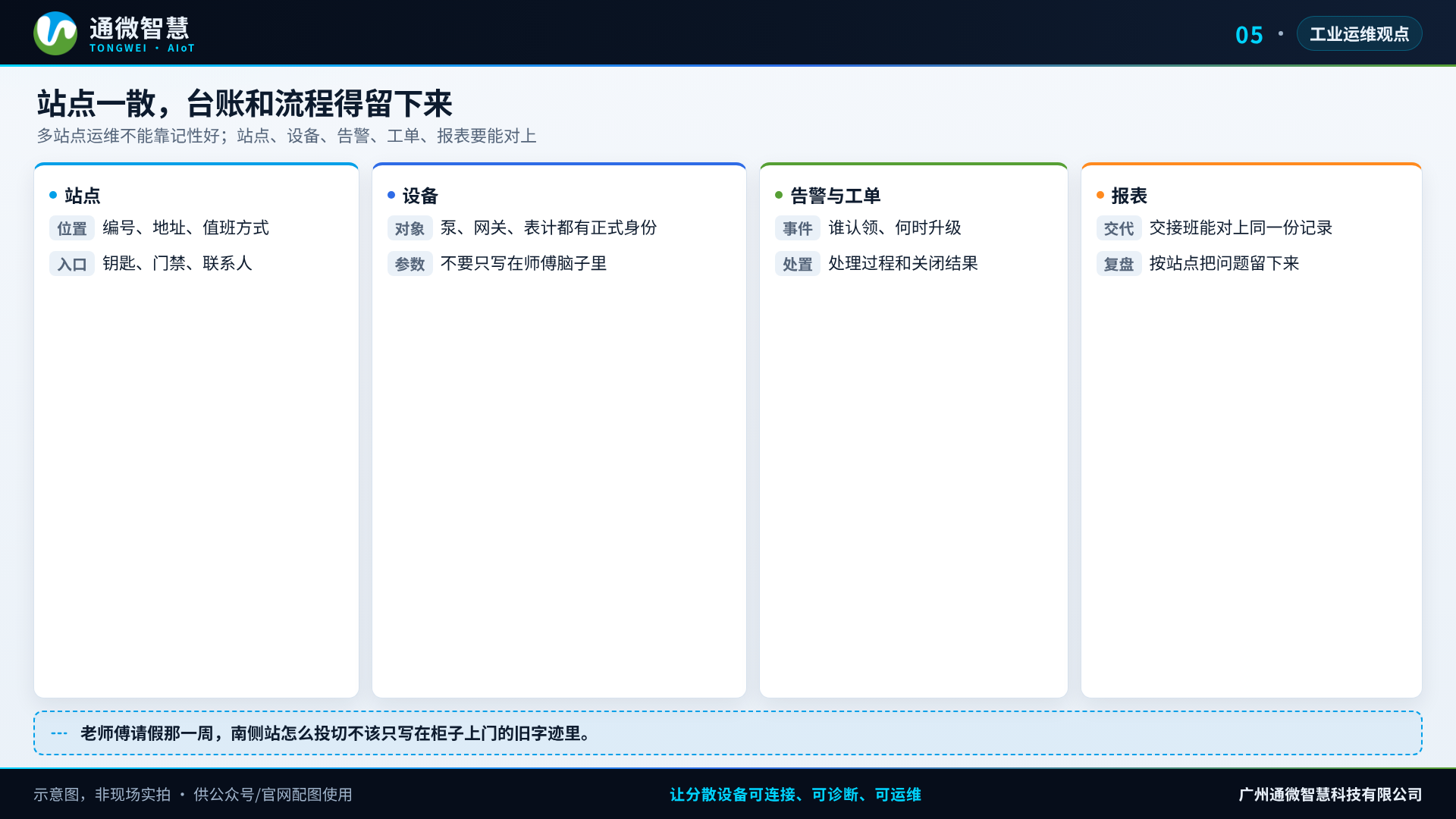
After the sites multiply, the process is what splits first
With one site, who is on duty, which equipment is temperamental, and how the last fault was handled can be passed among a few people. Once the number of sites rises, it cannot. Some sites still use a paper inspection sheet. Some send photos into different groups. Some keep records only on a technician's personal phone. When an operations note is due at month end, the only way is to piece tables and chat records together.
Alarms also fail to reach the right person. The air-conditioning alarm at this site goes into the property group. The power-distribution alarm at that site goes only to a personal WeChat. The push account of yet another site was stopped long ago. After an exception appears, it is found late, and finding someone who can go out takes several more handoffs. This is especially clear at night: few people can be called, and the person called may not have the keys and drawings for that site.
Inspection also slides into "clocking in". The person arrives, takes a photo of the front, and ticks the items on the sheet quickly. Whether the equipment is running abnormally, and whether the last rectification was followed up, is not necessarily written down. Management sees an inspection completion rate. What the site lacks is content that can be checked.
Staff turnover magnifies the problem. When the person who knows the place leaves, the new person faces a row of similar station rooms and can only ask one by one and search one by one. Equipment names are not unified, drawing versions do not match, and which site holds the spare parts has to be found on the spot. Operations quality travels with the person. When the person changes, a stretch of that quality breaks.
Leaning on experienced people cannot be copied
Many teams instinctively solve this by having the old hands show the others a bit more. That works at two or three sites. Once there are many sites, the old hands become the bottleneck: they rush to site by day and still take enquiry calls at night, and their own records get written less and less.
A large screen alone does not solve the memory problem. A large screen can spread out the current state. It does not tell you who handled it last time, whether a spare part was replaced, or whether this is the third time the same fault has appeared this week. Without a ledger, work orders, and reports, a large screen only turns scattered sites into a concentrated "now". The present is busy. The past and the responsibility are still empty.
Another method is to install a separate small system at each site. It can be handed over at the time. A year later the accounts are each managed on their own, the rules are not unified, and the monthly report is still summarised by hand. Multi-site operations need one process that can be copied, not several more pieces of software that do not talk to each other.
First make one site's loop into a shape that can be copied
Tongwei Smart delivers multi-site smart operations as one standard package in the solution pairing: let one site run connection, monitoring, alarms, handling, and review through, then lay the same structure onto the other sites.
Build a unified ledger first. Sites, equipment, key points, responsible people, and the duty arrangement sit together, and the naming rule is fixed. One piece of equipment should not use three names across the drawing, the platform, and the work order. Someone has to maintain the ledger. Equipment replacement and points added or removed leave a version. It cannot rely on spoken updates for long.
Then connect alarms and responsibility to people. Grading, notification, and the escalation path are set to the roster of that site. A public group can be used for notice. It cannot replace acknowledgement. Who is on duty and who is the relief should be look-up-able on the platform, so that at night nobody is left flipping through a phone book from memory.
Then come work orders and inspection. An alarm can generate a work order, and a planned inspection can generate a task. Feedback from site must be able to bring back status, photos, and a short conclusion. The close condition is written in advance, so the words "already handled" do not end the record. A problem that repeats should be visible, rather than being dispatched as a new problem every time.
Reports come out for operations needs. Do not ask for the numbers only at month end. Which sites have a long offline duration, which alarms keep returning, the average work-order close cycle, and where inspection items are missing should be available directly. The role of an industrial-grade AIoT platform here is to bring scattered sites onto the same chain, not to add another screen that is only there for visits.
Site onboarding still has to be solid. Instruments, power distribution, environment values, and access status in the station room usually enter the platform through an industrial gateway, bringing scattered equipment into the same IoT ledger. The protocol and the point list are assessed per site. First keep the points that must be seen stable, then talk about comparison across sites. Sites with different network and power conditions can use different acquisition strategies. Do not cut them all the same way.
When copying to the second site, do not copy only the interface. Take the verified equipment models, point lists, alarm grades, and work-order templates across, then handle what is different at this site: a different communications method, a different duty roster, and some equipment that cannot be connected yet. Differences are written on a list, so it is later possible to judge whether a problem belongs to that site or the template needs a change. Training has to keep up. At least the people on duty must know how to acknowledge, how to close an order, and how to send a result back from a mobile device. Otherwise the system is in, and the memory is still held by a few people.
Before copying, write the boundary on paper
Not every site can be cut over on the same day. Some sites do not have the network. At some sites the equipment list cannot be matched for the moment. These should be marked as pending, and the sites that are ready go first. Whether remote control is opened, whether data sits in the cloud or on site, how to connect with a system the property or the group already has, and traffic, notification cost, acceptance indicators, and later service are confirmed per project.
Offline cache and local interlock are implemented as configured. A site that is not configured that way should not be required to show a complete curve on the centre side as well. Tongwei Smart does not replace fire, access-control, and site protection systems. It only brings status into the operations process inside the agreed range. Installation on site and the acceptance interface are usually the owner's or the integrator's responsibility, and have to be drawn at the solution stage.
Start from a pilot assessment of one site
If it already feels that "once one person is on leave, the sites get out of control", start a single-site pilot assessment. Pick a site whose equipment is fairly complete and whose duty conflict is typical, run the ledger, the alarms, and the work orders for one cycle, and see whether this method can leave one person's memory behind. If it runs through, then talk about copying. If it does not, change the rules first. Do not rush to roll it out.