
A UPS battery in an office takes over when the utility supply is abnormal. A solar monitoring point on a hillside may have to run on its battery after dark. Both sites have batteries, but the duty operator has a different job once the alarm arrives. When Guangzhou Tongwei Smart Technology Co., Ltd. (Tongwei Smart) connects standby power for the IoT and pairs an AIoT solution, the first questions are which equipment this string supplies, who takes over after a power loss, and what judgement the data already on site can support.
Compare the four supply tasks
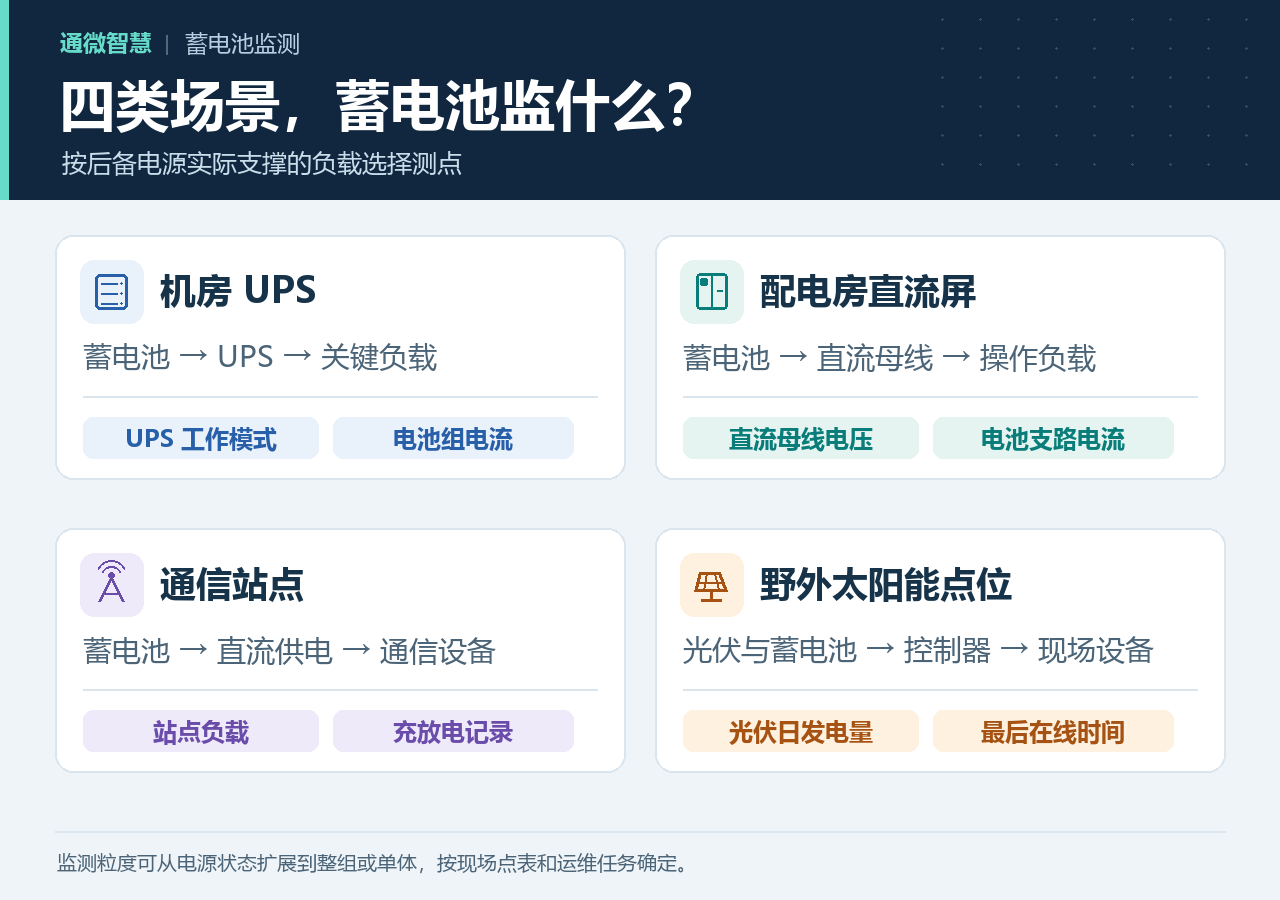
| Site | When the battery takes over | What to watch first | What to check after an exception |
|---|---|---|---|
| UPS in an equipment room or an integrated cabinet | Utility interruption or an input exception, depending on the UPS configuration | UPS operating mode, output load, string current, battery alarms | Whether the output continues, whether the load has changed, and whether a cell exception was recorded |
| DC panel in a power distribution room | When AC supply or a charging branch is abnormal, the panel carries the DC load according to the system layout | Charger status, DC bus voltage, battery-string current, branch and insulation alarms | Whether the exception comes from the charger, the battery string, a DC feeder, or the monitoring path |
| Telecom site | When the AC supply is disturbed, the battery supports the DC telecom load | Rectifier status, site load, battery charge and discharge current, recharge record | Whether recharge was completed before this outage, and whether the load is higher than usual |
| Remote solar site | At night, in rain, or when sunlight is insufficient, the battery supplies the load | Daily photovoltaic generation, battery trend, load output status, last time online | Insufficient charge, a load change, a protective shutdown, or a communications-path exception |
For a UPS, start from the host panel or the event log. For a DC panel, compare the charger, the bus, and the battery string. An outage at a telecom site also has to be traced back to the recharge conditions before it. A remote site may lose communications before the voltage has fallen far, so when an offline notice arrives, look first for the last valid operating record.
Choose points at system, string, or cell level
A site that only needs to confirm whether standby power has taken over can start with operating mode, input and output status, and outage events. To answer which string took part in the discharge, the matching string voltage, branch current, and data source are needed. When several strings are in parallel, the total current of the whole machine usually cannot show how much load each string actually carried. Whether to add branch measurement depends on the operations need.
Cell-by-cell monitoring is worth evaluating when the question is which cell went abnormal first. A core equipment room with a high standby-power duty and difficult site inspection can give maintenance staff a clear object to retest from cell voltage and temperature. The other way around, a small site that can be reached quickly, where the time is mostly spent judging whether power or the network failed first, should first line up controller status, device online status, and the time of the last valid data.
Start from one site list
Record four things for each site. First, which loads the power supply actually protects. Second, the business consequence of an interruption. Third, which fields the site can open. Fourth, which step is owned by the duty shift, by maintenance, and by site management. Equipment of the same model can still expose different fields because of the communications card, the firmware, or the wiring. Check the actual unit during a pilot.
An industrial gateway can send data from the power supply, the instruments, and the online detection devices into the IoT platform. For a Tongwei Smart AIoT scene solution, a pilot should be able to say which alarm has been confirmed, which readings are missing, and who needs to check next. An operations team that already has power models, a single-line diagram, and an inspection sheet can compare one critical site with one ordinary site, and ask Tongwei Smart to assess the point range together.