
On summer inspection rounds of roofs or equipment platforms, air-conditioner outdoor units are often found hemmed in by cartons, scrap, temporary racks, or reflective insulation. Stacked items obstruct inlet air and heat rejection, and can indeed trigger high-pressure protection or frequent shutdowns. High-pressure protection can equally come from refrigerant charge, a fan fault, high ambient temperature, or an overdue maintenance interval. A single site photo cannot establish the cause, and cleanup cannot be followed by a guarantee that every shutdown will disappear. When Guangzhou Tongwei Smart Technology Co., Ltd. (Tongwei Smart) handles this kind of problem, it separates two things: keep the outdoor-unit inspection and the indoor fault records, and hand the equipment to a qualified maintenance contractor for inspection. IoT monitoring can mark when the fault occurred and how the indoor temperature changed at that time. The solution package does not replace the cleanup work, and industrial-grade AIoT does not perform stacked-item recognition or automatic root-cause judgment here.
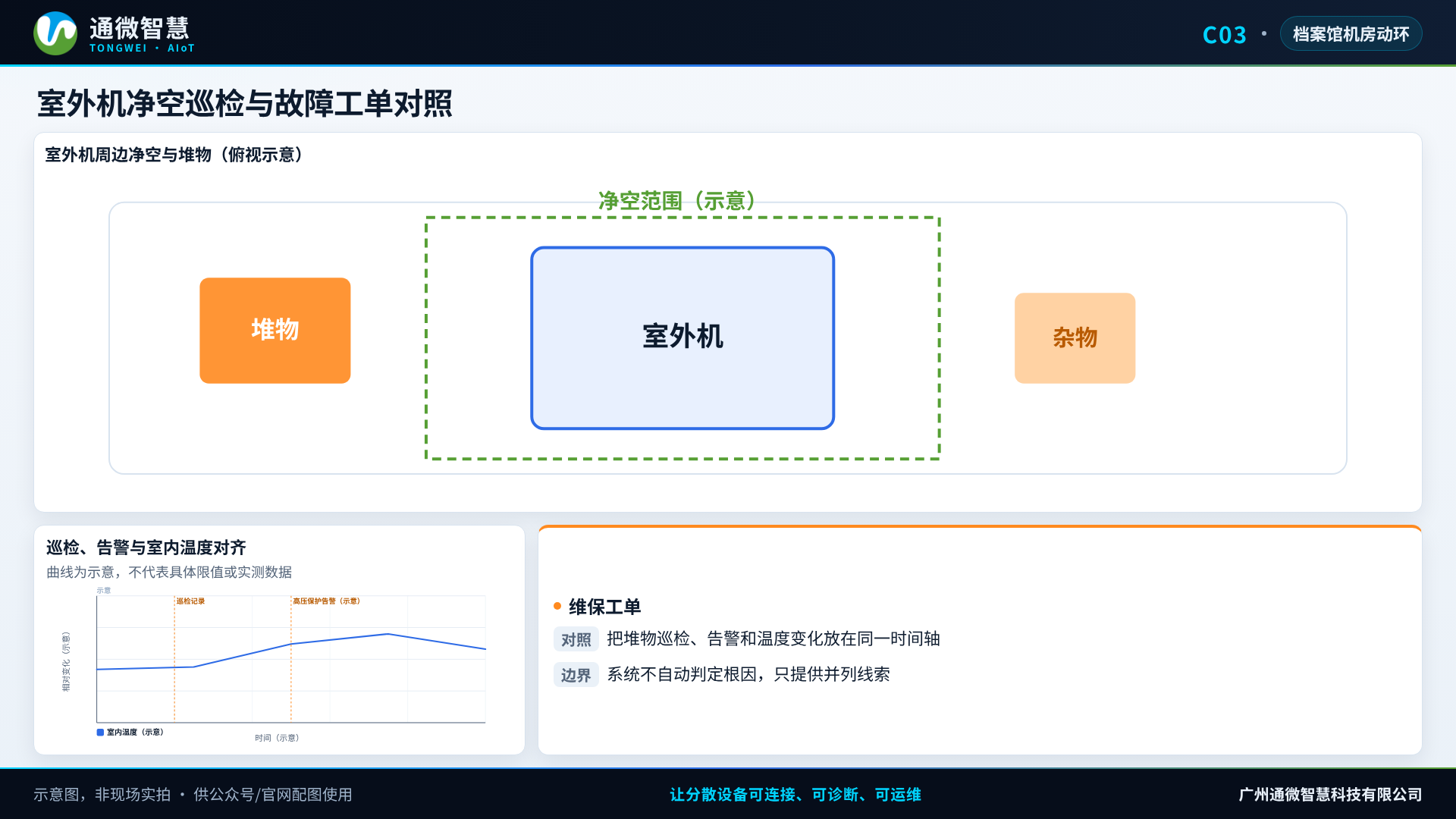
Put stacked items, heat-rejection conditions, and historical faults on one timeline
At the outdoor unit, check clearance, whether discharge air is blocked, and whether the fins are heavily fouled or deformed. At the same time, pull recent records of high-pressure protection, shutdowns, and indoor temperature limit exceedances. Note where the items are stacked, which department stacked them, who should clear them, and whether the fault time coincides with the stacking, high temperature, or an interrupted cleaning. Clearance and installation requirements from the manufacturer’s installation instructions should be attached to the record, as the basis for the maintenance inspection, rather than having the monitoring platform directly “judge a violation.”
If there is already a burning smell, obvious deformation, or debris already touching live parts or rotating parts, follow the site safety rules first. Do not approach a running fan to take a makeup photo, and do not wash a live unit yourself.
In an archives building, the outdoor unit often shares an equipment platform with repository humidification, dehumidification, or the building’s multi-split system. The stacked items do not necessarily come from equipment-room operations. They may have been placed temporarily by property management or left by a construction crew. So the inspection sheet has to record more than “whether something is blocking it.” It also has to name the occupying department, the planned cleanup date, and the person who will recheck. Photos that circulate only inside the information department often do not get the items on site removed.
Seasonal change also belongs in the observation: the plum-rain season and midsummer are the periods when high-pressure protection and drainage problems are most common, and after winter begins, frosting, abnormal defrost, and restart after a long shutdown need closer attention. Writing these time windows into the inspection plan is more useful than taking a makeup photo only after a fault has already occurred.
Make outdoor-unit inspection a fixed work order, not something noticed in passing
Outdoor units for an archives annex equipment room are often installed on a roof or in a courtyard on another floor. Daily traffic does not pass there, and the problem is often remembered only after the room indoors is already hot. Write “whether clearance is occupied, dust buildup, abnormal noise, icing or frosting, and whether drainage is clear” as regular inspection items. Confirm them on site with mobile inspection or an electronic ledger, and an overdue inspection must be able to remind the responsible person. On the indoor side, a smart IoT gateway collects air-conditioner fault signals and room and cabinet inlet-air temperature. An equipment room with concentrated equipment can use an SG series rack-mount edge gateway. If local status also needs to be collected near the outdoor unit, then evaluate whether to use the BEC series. What needs to be stated clearly is that the gateway receives equipment alarms and indoor environment trends, not an automatic recognition result for items stacked around the outdoor unit.
Tongwei Smart can associate overdue inspections, air-conditioner faults, and indoor temperature limit exceedances on the same work order, so maintenance staff can see time patterns such as “clearance was occupied before several consecutive high-temperature events.” This is supporting material only. The root cause still has to be confirmed on site. AIoT reports can count fault frequency and inspection items that are not closed, for the monthly report, but image recognition of stacked items is not written up as a capability already delivered.
Cleanup and repair follow the safety rules. Monitoring only compares before and after correction
Debris removal, fin cleaning, refrigerant charging, or fan replacement is carried out by property management or the air-conditioner maintenance contractor under an approved work method. Do not disassemble live equipment yourself or wash it with water. After correction, compare fault records and indoor temperature trends under similar weather and load, and have the maintenance party issue an opinion. The platform keeps the pre-correction inspection notes, photo descriptions, and work-order close records as they are, for later review, and does not claim that the environmental problem has been eliminated.
Notification rules need to be written at the same time: high-pressure protection and unit shutdown should reach the person on duty and the maintenance staff immediately by SMS, phone, or WeChat. Stacked items found on inspection are assigned to the responsible department as agreed, and escalate if not handled when overdue. A failed send on a channel must be detectable. Remote start and stop is not carried out outside an authorized scope. Unit protection logic remains the responsibility of the original equipment.
Another deviation to avoid is treating “the fault code is visible on the platform” as outdoor-unit management already completed. A fault code only shows that unit protection has operated. It does not show whether the roof unit is still surrounded by stacked items at that moment, and it does not show whether heat rejection recovered after cleanup. So the minimum complete record for close-out should include: the site notes from the inspection, the time the fault occurred, the indoor temperature change, the time cleanup or repair was finished, and whether the maintenance party confirmed that normal observation can resume. If any of these is missing, the monthly report should not say “the problem has been fully resolved.”
Acceptance looks at whether the records match, not at whether the yard happens to have just been cleared
Spot-check whether an inspection was completed on site rather than filled in afterward. Spot-check whether a fault work order includes the time of occurrence and the indoor temperature curve. Then see whether there is maintenance confirmation after correction. When testing notifications, do not deliberately keep a unit running with heat rejection blocked.
Start with the outdoor unit that faults most often
Hand the outdoor-unit location plan, the maintenance contractor, the fault signals that can be collected, and the existing inspection sheet to Tongwei Smart, and run inspection, alarms, and work orders through for this one unit first. On equipment-room power and environment projects, Tongwei usually closes this one line first, and decides whether to bring other outdoor units into the same ledger only after confirming that the records are useful to operations.