
Some equipment rooms place one temperature and humidity meter in the center of the room. The reading looks acceptable, but opening a cabinet door shows the upper part already noticeably hot and the lower part still relatively cool. The original list describes this contrast as “35℃ at the top, 22℃ at the bottom.” That is only a site scenario. It is not a measured result from any particular project, and it cannot be used as a general threshold. The average room temperature does not describe the inlet-air condition of every cabinet: heat load, supply-air path, and cable obstruction can differ by height and by row. In the equipment-room power and environment solution package, Guangzhou Tongwei Smart Technology Co., Ltd. (Tongwei Smart) treats sensor placement as work that has to be written into the ledger, rather than hanging a few probes somewhere in the room. Industrial-grade AIoT can keep recording temperature trends by zone and by height and notify when a limit is exceeded, but the cause of an exceedance still has to be checked against cooling, load, and airflow. The IoT platform does not directly give a standard answer for “how many degrees of difference there should be.”
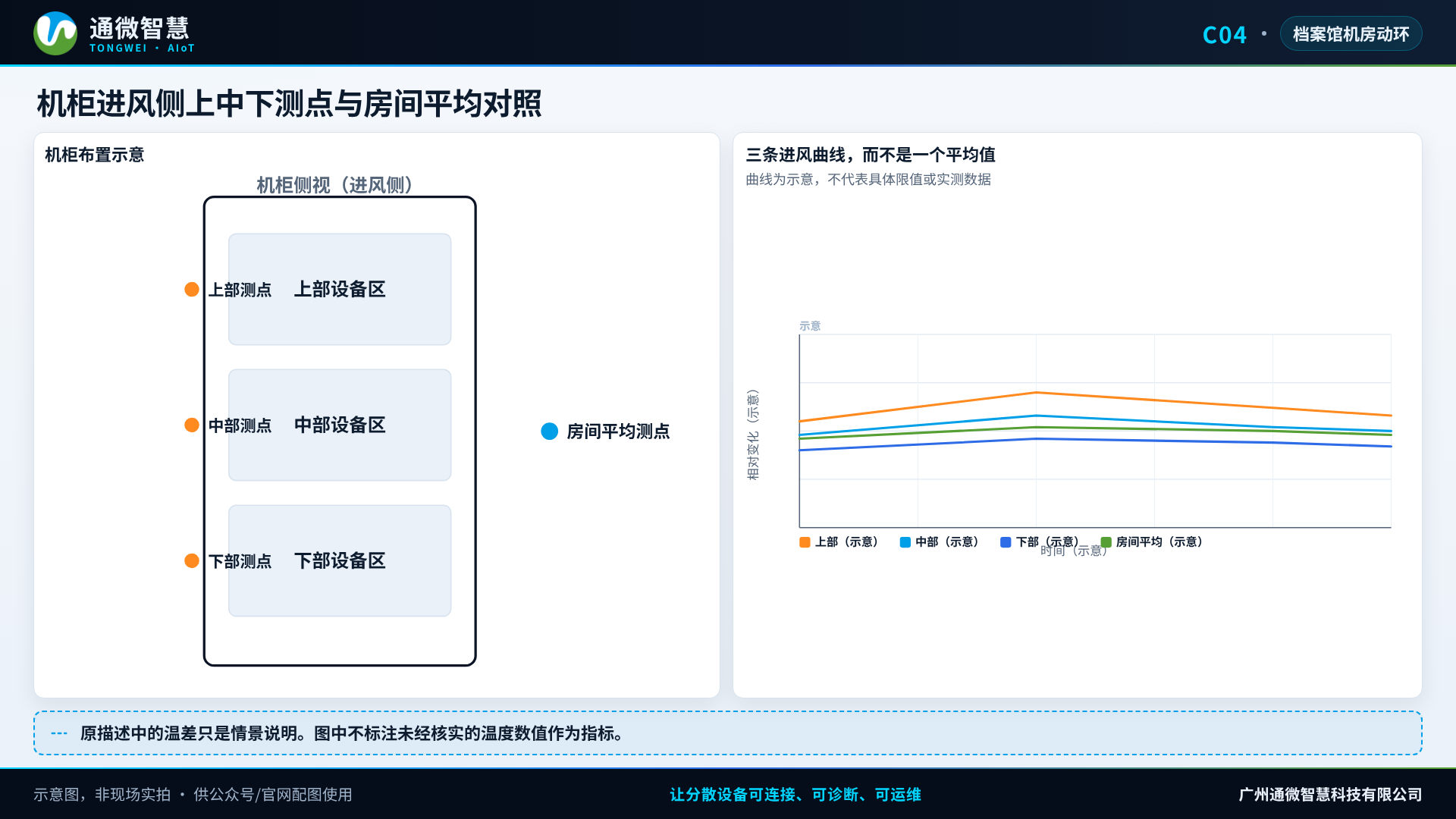
Point the sensors at inlet air, not at the easiest place to drill
Before placing points, look at the cabinet layout, supply and return air direction, the main heat-producing equipment, and hot spots that have already shown up. Representative points usually need to cover the upper, middle, and lower inlet side of the cold aisle or the cabinet, the room return air or the precision air-conditioner return, and cabinets that have already run hot. Probes should sit as close as practical to equipment inlet air, and should avoid interference from a position facing the exhaust, direct sun, or a cabinet door that is often open. After installation, the ledger should state the sensor position relative to the cabinet, the U position, and the height, and the calibration status or a comparison record should be checked.
After equipment is replaced, cabinets are moved, or partitions are changed, the old points do not necessarily still represent the old risk. When the layout changes, walk through a point review again. Do not keep using a point drawing from several years ago.
During cabling, also watch for the probe itself being pinched, coming loose, or falling off because of cables, labels, or the cabinet-door seal. Many “sudden high-temperature alarms” turn out, on investigation, to be a probe that left the inlet-air position or fell into the cabinet exhaust zone. Inspection items should include whether the probe is still at the marked position, whether the cable has come loose, and whether the reading roughly matches a handheld meter. When the deviation is obvious, mark it as pending verification first, then arrange calibration or replacement. Do not cover the problem by changing the threshold directly.
If only a few probes can be installed for now, cover the cabinets with the worst inlet-air conditions and the most critical service first, rather than hanging one evenly in each corner of the room. An average of the four corners looks complete, but it may just miss the real hot spot. Where point coverage is incomplete, write the coverage range in the ledger and the monthly report, so a reader does not assume the whole equipment room has already been measured.
Look at the problem with zone trends, not with an alarm on one room average
Connect these points to a smart IoT gateway and look at trends by cabinet or by aisle. An equipment room with concentrated cabling suits an SG series rack-mount edge gateway for bringing together a larger number of temperature and humidity points. Where an integrated cabinet has fewer internal points, the BEC series can be evaluated. Thresholds cannot be copied from another equipment room, and the scenario numbers in the original list cannot be treated as design values. They should be confirmed jointly by operations and the facility lead, based on the equipment manufacturer’s recommendations, the equipment-room design, and the range the business can accept. A short swing caused by an open door can be reduced, as meaningless disturbance, with a delay or a combined condition. Sustained layered overheating cannot be wiped out by “averaging it.”
What Tongwei Smart does at this step is make the top-to-bottom temperature difference visible, recorded, and assigned. It does not promise that monitoring will fix the airflow arrangement. When the upper part of a cabinet stays high, the work order should state the point location, the start and end time, and the air-conditioner operating state at the time, and be handed to the facility team or the integrator to check supply air, blanking panels, baffles, or load. AIoT reports can list each point’s highest value together with the time and location, for the monthly report. Periods with missing measurements have to be marked. They cannot be filled with a neighboring probe’s number.
Alarm grades also have to follow what the point means. Sustained inlet-air limit exceedance on a critical cabinet should reach the person on duty by SMS, phone, or WeChat. A slight departure on an ordinary environment point can go to a to-do list. A failed notification must be able to check itself. Remote changes to the air-conditioner setpoint are outside the default scope of monitoring. If that is to be done, permissions, audit, and responsibility of the original control system have to be agreed separately.
The top-to-bottom temperature difference itself should not be the only alarm condition. Some cabinets have a clear vertical gradient by design. As long as inlet air is still within the range the equipment allows, that is not necessarily a fault. The reverse case matters more for immediate action: the top-to-bottom difference is small, but inlet air as a whole is already high. So the rule should first protect “whether inlet air is acceptable,” and write the layered difference into the work order as an analysis clue, rather than frequently disturbing the duty staff with a temperature-difference limit that has no source.
Compare under similar load, and remember that the scenario numbers are not acceptance criteria
Pick a period when the business is relatively stable, and record each point’s reading, the collection time, and the probe position. After airflow is corrected or equipment is adjusted, measure again under the same set of conditions. Acceptance looks at whether the points still represent inlet-air conditions, whether alarms can reach a person, and whether the retest record is complete. It does not look at whether some top-to-bottom difference has been pulled in to a target value that has no source.
If the correction includes adding blanking panels, changing perforated floor tiles, or moving equipment, write the change and the person who approved it in the work order, and use the same set of points for the retest. If a point is moved and the ledger is not updated, the comparison is no longer valid. These process records look tedious, but they are the most useful basis later when capacity is added or a hot spot has to be traced.
Pilot the layout on one row or one problem cabinet
Hand the cabinet plan, the supply-air method, the existing probe positions, and recent high-temperature records to Tongwei Smart, and first complete placement, connection, and alarm verification on one row or on the cabinet with the most complaints. On equipment-room power and environment projects, Tongwei usually makes the representativeness of this set of points solid first, and then decides whether to extend it to the whole room.