
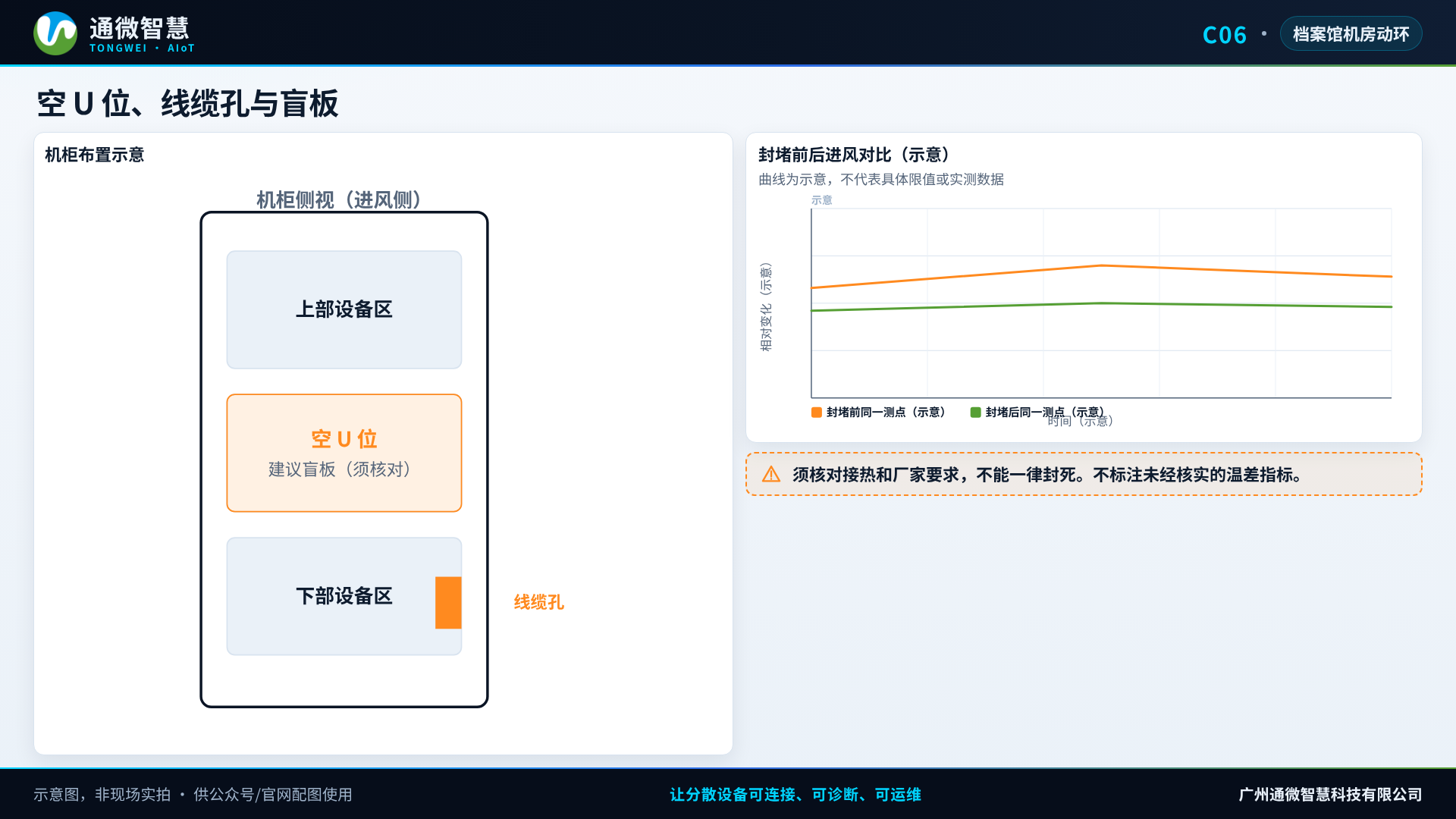
Empty U positions in a cabinet, cable-entry openings at the back, and cabinet doors that are not fully closed look like “equipment has not been installed yet,” but they can let cold and hot air mix inside the cabinet. Cold air can leave through an empty position into the hot aisle before it passes the equipment, and hot air can also fold back to the inlet side through an opening. The result is that the air conditioner works harder, while the inlet air of some equipment is still not cold. How large this effect is depends on whether the aisle is contained, on the pressure difference, and on the site load. Not every temperature problem can be blamed on “no blanking panels,” and not every opening can be sealed shut, or the seal may block cooling the equipment itself needs or violate the manufacturer’s installation requirements. In the equipment-room power and environment solution package, Guangzhou Tongwei Smart Technology Co., Ltd. (Tongwei Smart) treats blanking panels and opening management as site work that can enter inspection and work orders. IoT monitoring is used to observe the inlet-air temperature change before and after correction. Industrial-grade AIoT does not automatically decide which opening should be sealed here.
Register empty positions, openings, and door state first
During inspection, check cabinet by cabinet: which U positions are empty and have no blanking panel, whether cable openings are sealed, whether the cabinet door can close, and whether floor openings are still open. Record the locations in the cabinet ledger, rather than only remembering that “there seem to be a few empty positions.” Priority has to be ranked against the actual airflow and the temperature points. Cabinets whose inlet air is already high, and whose empty positions sit on the inlet-air path, should be handled first. A position with very low load and a very small opening can go on the plan. It does not have to be mixed in with emergency cooling.
Before installing blanking panels or sealing parts, check equipment cooling requirements, cable bend radius, and constraints from fire protection and structural load. Some equipment needs a specific front-to-back airflow path. Some cable openings have to stay serviceable. Those judgments are made by equipment-room specialists. The monitoring system only provides the temperature change as a reference.
Empty positions are often left after an urgent install or a temporary removal. A construction crew in a hurry may set the blanking panels aside and leave, and nobody writes them back onto the checklist afterward. So the ledger has to record more than “which U positions are empty now.” It also has to record “which seals should be restored after this change, and who rechecks them.” Without that item, inspection easily becomes an occasional photo of a cabinet door.
When sealing, also separate openings that may be sealed from openings that must stay open. Empty U positions on the inlet-air path usually get blanking panels first. An opening the equipment marks as required for cooling cannot be sealed. Openings related to fire protection or pressure relief must not be altered without authorization. Writing these categories into the inspection notes reduces two extremes: “seal every hole you see,” and “do nothing because sealing the wrong one is a risk.”
Monitoring is for seeing change. It does not replace sealing design
If inlet-air and exhaust-air temperature points already exist, a smart IoT gateway can keep recording the trend before and after correction. A concentrated equipment room can use an SG series rack-mount edge gateway to bring these points together. Where an integrated cabinet has fewer internal points, the BEC series can be evaluated. Point positions should still be as close as practical to inlet air, so the probe itself is not facing hot recirculation formed by an empty position. For a cabinet with no points, do not use the room average to “prove” that blanking panels have already taken effect.
Tongwei Smart can write “empty position not sealed” as an inspection item. If it stays unhandled past the due time, it enters a work order, and the work order attaches the temperature curve of the corresponding point. What the facility staff then see is not a vague “please correct this soon,” but which cabinet, which openings, and whether temperature has already been affected. AIoT reports can count inspection items that are not closed and the related limit-exceedance counts. They do not write a missing blanking panel as the only root cause, and they do not give an energy-saving percentage that has no measurement behind it.
Alarms should still be set around whether inlet air is acceptable. A swing caused by a short door opening for install or removal can use a delay to reduce disturbance. A sustained high reading has to notify the person on duty and the facility staff. A failed notification must be able to check itself. Remote opening and closing of cabinet doors, or a demand to “seal everything” before it has been assessed, are both outside the default capability of monitoring.
If only some cabinets in the same row have blanking panels and others do not, the comparison has to name what is being compared. A row average cannot be used to judge the effect on one cabinet. Load changes, air-conditioner cleaning, or a change to aisle containment can happen at the same time as sealing. Work orders and the monthly report should record these parallel changes, so that later every temperature swing is not explained as a blanking-panel problem, and so that the opposite conclusion, “blanking panels were installed but did nothing,” is not drawn either.
Compare before and after with the same points and similar conditions
After blanking panels are installed or sealing is finished, retest the original points under similar load and air-conditioner operating conditions, and record the time, the cabinet ID, and openings that are still unhandled. Do not attribute every temperature improvement, or every lack of improvement, to this one sealing job, because equipment may have been installed, an air outlet changed, or the air conditioner cleaned at the same time. Acceptance looks at whether the ledger was updated, whether the work order was closed, and whether the retest conditions were written down.
In an acceptance sample, look both at whether positions that were sealed are still sealed, and at whether an inspection item will automatically become a to-do the next time equipment is installed. If the system cannot remind anyone to restore the seal after a change, the close-out is still a one-time event. If a sealing part comes loose, the size does not match, or it blocks cooling that is required, stop immediately and hand the problem back to a specialist, rather than continuing the installation in order to “complete the correction rate.”
Pilot on the cabinet with the most empty positions and high inlet air
Hand the cabinet plan, the empty-position list, and the existing temperature points to Tongwei Smart, and first complete the inspection item, sealing observation, and alarm verification on one typical cabinet. On equipment-room power and environment sites, Tongwei usually completes the record for this one cabinet first, and then decides whether to extend blanking-panel and opening checks to the whole row or the whole room. When extending, cooling and opening category still have to be checked cabinet by cabinet, so the sealing practice from the pilot is not applied without distinction to every piece of equipment.