
On the duty desk, someone handed a level curve that was missing two hours to a chat model and asked it to judge why the pump was starting and stopping so often. The chart was broken, but the conclusion was written as if it were complete. At industrial-grade AIoT (AI + IoT) sites, Guangzhou Tongwei Smart Technology Co., Ltd. (Tongwei Smart) treats a different step as first: get the acquisition complete and the alarms sorted before asking whether an analysis can stand. However well a model can talk, it still needs numbers that match.
The chat window is busy, but the evidence is often thin
Many people's first impression of industrial AI is that it can answer questions, write reports, and explain a fault so that it sounds right. In a station house, what gets stuck is often not the inability to ask, but the lack of a complete record at the moment of asking.
I have seen a typical use. The night shift drops that day's alarm screenshots into a dialog and asks which one to handle first. The model produces a tidy paragraph, even a ranked order. Among those alarms, half were downstream devices going offline because one gateway link dropped, and several were repeated limit breaches from a probe that was jittering. The model had no work order to check against, and it could not see who had already gone on site, so it could only improvise from the titles.
The points themselves are often unclean. The register table was checked against the manual once. Later the transmitter was replaced and the multiplier was not changed. The numbers still look readable, but they no longer match the site. The same point is called "1# pump running" on the drawing, "P1_RUN" in the meter, and "east sewage pump" in the duty log. The person who reconciled them once can still fill the gap from memory. After a shift change, the model is reading three sets of names.
The time the link was down tests the evidence more. A stretch of the curve is empty, but the pump still started on site as it should. The local logic did not stop. If the gap is later filled with 0, analysis treats "not acquired" as "stopped" or "returned to zero". A model that can talk well, fed a fragment like that, can only fill in a story.
Then there is the 99+ in the corner of the screen. Nobody opens it and nobody claims it, while the chat window keeps asking which alarm to look at tonight. Without grading, deduplication, or acknowledgement, the so-called intelligence stays verbal.
Putting the model up first and filling in acquisition later will not line up
Some teams used to build a polished dialog entry first, then go back and fill in acquisition and the ledger. The first two weeks of demonstration went smoothly. After some time in use, the problem showed: the answer depended on who was present that day, which stretch of data was still there, and whether the work order had been written. Change the shift, and yesterday's conclusion does not match today. When leadership asks again, the story has to be told from the start.
An industrial site does not need one elegant explanation. It needs the same kind of problem to still match the next time. That requires stable points, aligned clocks, alarms that can be traced to a specific device, and a disposition result that can be written back. These are the basics of an operations loop. Tuning model parameters does not replace a missing point list or a work order that was never closed.
Another older method is to pass a senior technician's experience by word of mouth and phone them when something happens. That can hold when there are few sites and the person is still there. Once sites are scattered, few people can be reached at night, and a phone call cannot show the live curve, so the judgment drifts. To keep the experience, there must first be data that can be checked, then disposition records that can be retrieved, rather than a talking interface first.
Run the loop first, then let analysis assist the judgment
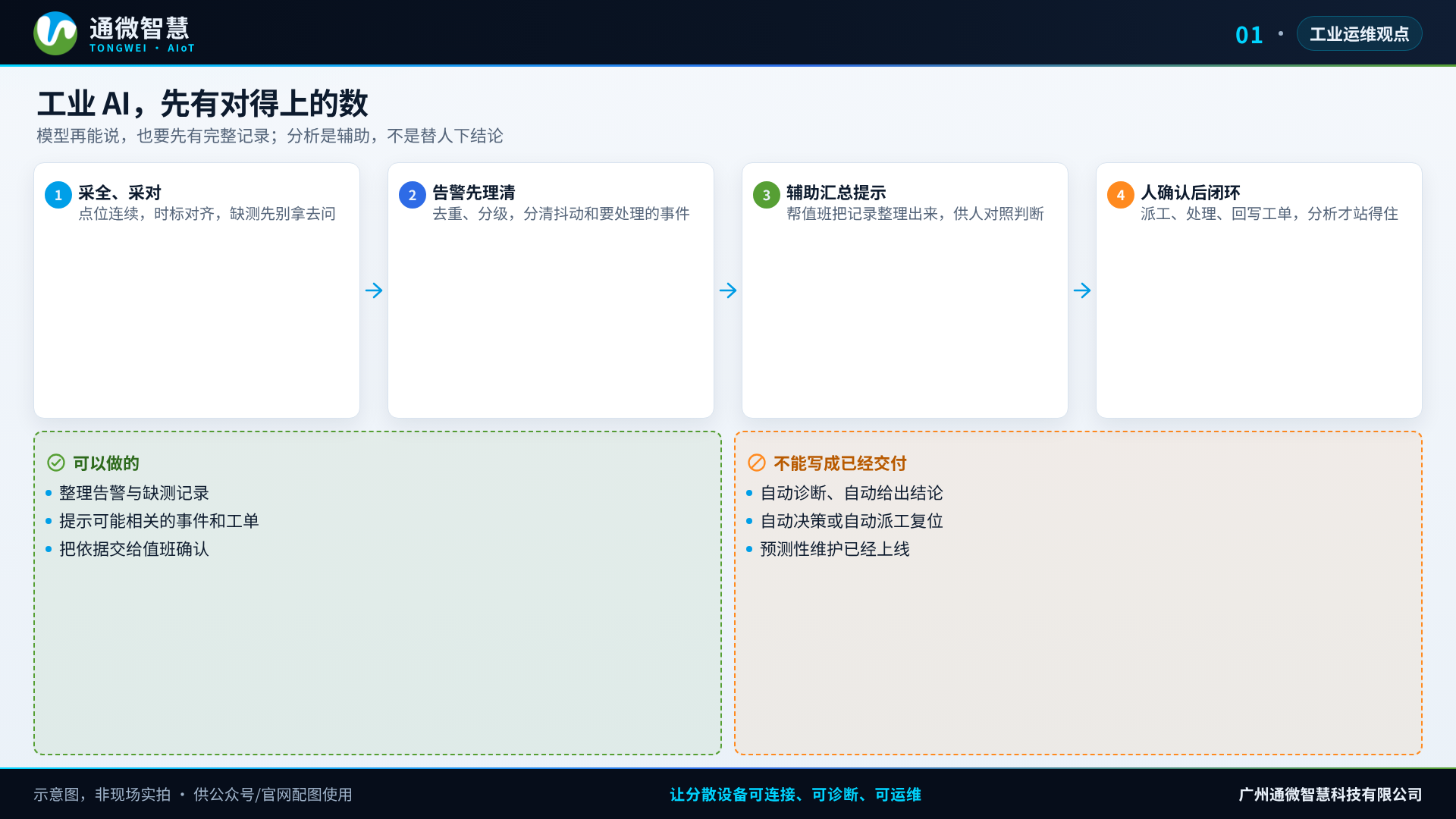
When Tongwei Smart handles this kind of request, "being able to chat" is usually not put first. The path looks slower, but each step can be accepted.
First, connect the equipment that should be connected. On site, a smart IoT gateway is often used for protocol conversion and point modelling. What can be matched goes online first. What cannot is confirmed item by item against the point list. Do not assume that opening the cabinet means everything can be acquired. RS485 wired in reverse, the wrong function code, and inconsistent byte order are routine during commissioning. They should show up on a prototype or a single site, not after the model goes online.
Second, turn monitoring and alarms into rules that can be checked. Online, offline, thresholds, state changes, and trend deviation each need trigger and recovery conditions written down. A string of messages from the same root cause should be collapsible. The responsible person is named as a person, not left as a shared group. Notification method and escalation time are confirmed by shift and by site. One set of rules is not applied to every station.
Third, the work order has to connect. Who takes it, who goes, what was done, and on what basis it was closed must be recorded. Resetting an alarm is not the same as finishing the job. If a model takes part, it reads these records and offers an assisting judgment for the person on duty to decide. It does not dispatch the job or change parameters itself.
Fourth, only then comes assisting analysis that can be verified. At this step, industrial-grade AIoT can compare historical work orders and related points and suggest that the case looks more like an upstream loss of power than ten devices failing at once. The prompt can be read. Whether to adopt it is a person's decision. If knowledge is to be kept, it comes from closed work orders and confirmed causes, not from the model's improvisation. Visible status, alarms that can be raised, and work orders that can close: if these three layers can be checked, they are worth doing first. Assisting analysis can follow, comparing related points and historical records to help a person narrow the search. What it offers is a reference, not a confirmed final cause.
Fifth, acceptance looks at the loop, not at whether the dialog is fluent. Take one week of alarms and work orders and check how many were merged, how many were acknowledged, how many were closed with a cause written, and how many recurred. Those numbers can be checked. Whether the dialog sounds like an expert is not an acceptance item. If one class of alarm keeps recurring, check the points and the rules first, then consider whether assisting analysis should be added. Do not reverse the order.
Promises that should not go into the contract at this stage
Predictive maintenance, automatic diagnosis guaranteed to be accurate, and equipment completing a disposition with nobody confirming it should not be written into the acceptance terms at this stage. Without a long enough run of continuous data, without fault labels, and without close records that a person has confirmed, there is no basis on which to check an accuracy rate.
A chat interface can be built. It is only an entry. Remote control needs layered authorization: read-only first, then opened point by point, with operations left in an audit trail. Data ownership, interface scope, whether deployment is in the cloud or in the customer's equipment room, and traffic and notification costs are confirmed per project. Tongwei Smart does not replace the on-site controller, protection devices, or safety interlocks. However familiar an analysis opinion is, it cannot cross those boundaries and change the control logic.
A packaged scheme can first run acquisition, alarms, and work orders through on one site, then decide whether an analysis module is added and where it sits. When it is added, it is still accepted as an assisting capability that can be verified, not as "already intelligent".
If you take one small step first
If the team is deciding which layer industrial AI should start from, a 20-minute requirements diagnosis can lay out the existing points, alarm rules, and breaks in the work-order path. Confirm first whether the data can support a judgment, then decide whether a model should be added.