
Someone changed a set of parameters remotely. After the site powered up, they did not match, and both sides said they had not touched the parameters. No operation log was left, and the login was still one account shared by several people. When Guangzhou Tongwei Smart Technology Co., Ltd. (Tongwei Smart) does remote equipment after-sales, it first makes the IoT link something that can be seen and traced. In an industrial-grade AIoT, "able to control" has to come later, and it has to be authorised in layers.
Being connected, and operating in a way someone can answer for, are not the same thing
After-sales needing to see equipment remotely is a legitimate need. The equipment is far away and the customer is in a hurry. Being able to judge first whether it is a power problem, a sensor problem, or a part that really has to be replaced can save many wasted trips. The problem is that "view" and "change" are often opened in the same step.
A common method is to give after-sales one account that can enter the equipment or the gateway. Everyone uses the same password, and once connected they can both view and write. Convenience is the aim at the time. A few months later the accounts no longer match: the site says nobody touched it, the remote side says they only looked, and a parameter has changed. There is no operation record, no second-person confirmation, and no permission limited by point. Afterwards each side tells its own story.
Another risk comes from timing. The equipment is running, and someone remotely changes one setpoint. The site may be under maintenance, or it may be waiting for material. Without first seeing the state clearly and checking with the people on site, a command sent straight down leaves it unclear who bears the consequence. Industrial sites are sensitive about remote control not out of caution for its own sake, but because the cost of a wrong operation is concrete, and it is often not in front of the person who operates.
The customer side worries as well. Once the equipment is in their workshop or station room, if the maker can change parameters and start or stop equipment at will, both safety responsibility and the management rules will be questioned. That worry is reasonable. For remote after-sales to hold, it has to answer first: who can view, who can change, what may be changed, how it is audited, and how a problem is traced afterwards.
Chasing "able to control everything" is hard to pull back later
Treating remote control as a highlight of the demonstration easily opens write permission early in the project. The demonstration is busy, and the rules do not keep up. When people change, the account is still there. When the working relationship changes, the entrance is still there. Once an opening of this kind is made wide, tightening it later meets resistance, because the site is already used to going fast.
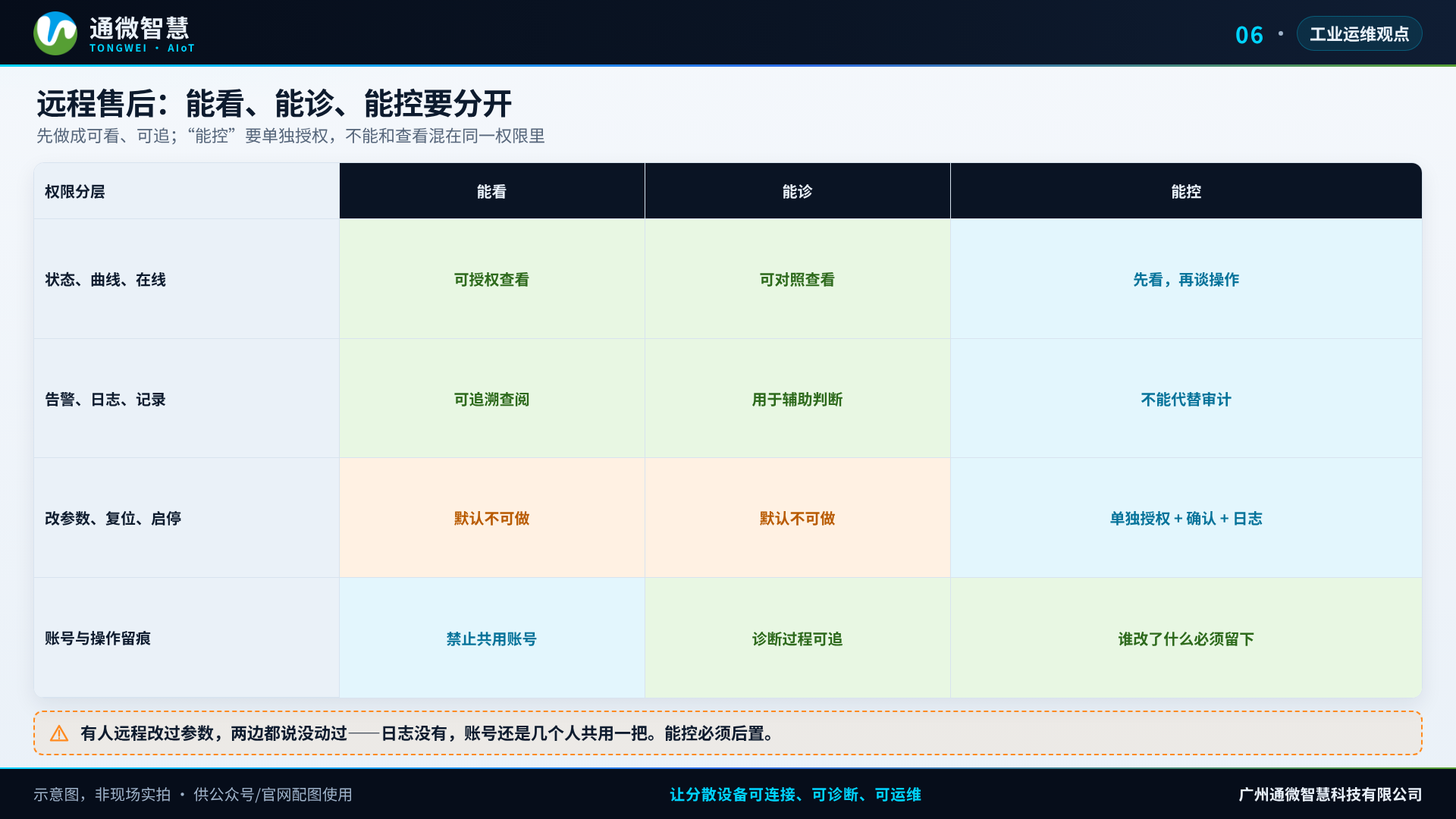
A verbal agreement is not enough either. "Do not change anything remotely unless there is no other way" sounds cautious, but without a system constraint one urgent call at night can wash the agreement away. A record filled in afterwards is often incomplete. The reliable method is to split read-only, diagnosis, and added control into explicit capabilities, leave the default on read-only, open added control by equipment, by person, and by time, and leave a trace.
Add remote after-sales in the order of view, diagnose, and control
In the standard product pairing, Tongwei Smart writes the remote after-sales path as a few steps that can be accepted, rather than handing after-sales an "all-capable entrance" in one go.
Step one is to make sure it can be viewed. After the equipment is onboarded through an industrial gateway, after-sales can see online status, fault words, key values, and a short curve, and can match a repair request to the current snapshot. This step does not open write permission. Being able to view already answers a large part of whether to send someone, and what parts to take.
Step two is being able to diagnose. Diagnosis means putting the status, the sequence of state changes, and similar historical work orders on the same view. When needed, the maker's engineer and the person on site work against the same screen. They can guide the site to check wiring, reset, or replace a module, but the instruction is carried out on site. This step is still mainly read-only, with voice coordination.
Step three is limited control. Which points are allowed to be operated remotely has to be listed by equipment type, for example refreshing some parameters that are not safety-related, or a reset inside an agreed range. Actions that involve process safety, electrical protection, or movement while a person is close to the equipment are not allowed remotely by default. An opened point needs a permission, a second confirmation, and an audit log, and it stays explicit that the original controller and the site procedure still own safety.
Step four designs the accounts and the process together. One person, one account. Long-term sharing is forbidden. When a person leaves, the permission is closed. An emergency addition of control at night can be a temporary authorisation that is withdrawn when it expires. Every remote-control action and every key read-only access should be traceable to a person and a time. The after-sales work order records whether remote control was used this time, what was operated, and what the result was.
Step five runs this boundary through on a prototype. Simulating a blocked wrong operation, an insufficient permission, and a query of the audit log is more persuasive than only demonstrating that something can be started remotely once. The value of an industrial-grade AIoT here is to turn coordination into a service capability that can be kept under control, rather than exposing site equipment as a button anyone can press.
The IoT onboarding layer has to be stable in the same way. If a point cannot be trusted, remote control is more dangerous. Until the meaning of the registers, the multipliers, and the control words has been checked, do not put the write function onto production equipment.
When talking with the customer's safety or information department, bring the permission table out. Do not only demonstrate that the link is up. The table should at least list which points a read-only role can see, what coordination a diagnosis role can do, which points a control role can operate, who has to approve, and how long the log is kept. Being able to say in the meeting what will not be done saves a lot of argument later in the project. If a demonstration must include one remote-control action, it should still go through the formal authorisation, and the audit record should be opened for everyone to see on the spot.
The safety boundary has to be written into the project confirmation
Tongwei Smart does not replace the equipment's existing controller, emergency stop, and safety interlock. The range of remote control, the way it is authorised, how long the audit is kept, where the data sits, and how it connects with a system the maker already has are confirmed per project. Equipment models and points that have not been assessed are marked as pending. They cannot be assumed to match the prototype.
During a network break, remote control is unavailable in any case, and the local side should keep its existing control logic. If a policy for caching or resending operations after recovery is to be turned on, it has to be implemented as configured, and it has to be explicit that a control command is never sent again automatically while the state is unclear. These points belong in the solution, not in a discussion after go-live.
Put the permissions and the point list on the selection list first
If the maker is already discussing remote after-sales, get a selection list first and write down the models to be onboarded, the read-only points, whether added control is needed, and how the accounts are graded. Once that list is in place, a prototype test will not turn into an exercise of connecting first and then seeing what can be changed. If the decision for now is not to add control, added control can still be listed as a later option, while read-only diagnosis and account audit are made the standard first.